


Fumba Town – Residential Town Project Website
For Fumba Town, the objective was to build a sophisticated digital platform capable of communicating far more than a residential development. The website needed to present an entire urban vision: a new coastal town in Zanzibar combining sustainable planning, curated housing, community infrastructure, lifestyle appeal, and international real-estate investment.
The project therefore required a balance between destination branding, property marketing, urban-planning communication, investor education, and lead generation. Rather than behaving like a conventional property catalogue, the platform positions Fumba Town as a complete place to live, invest, work, and belong.

Project Context
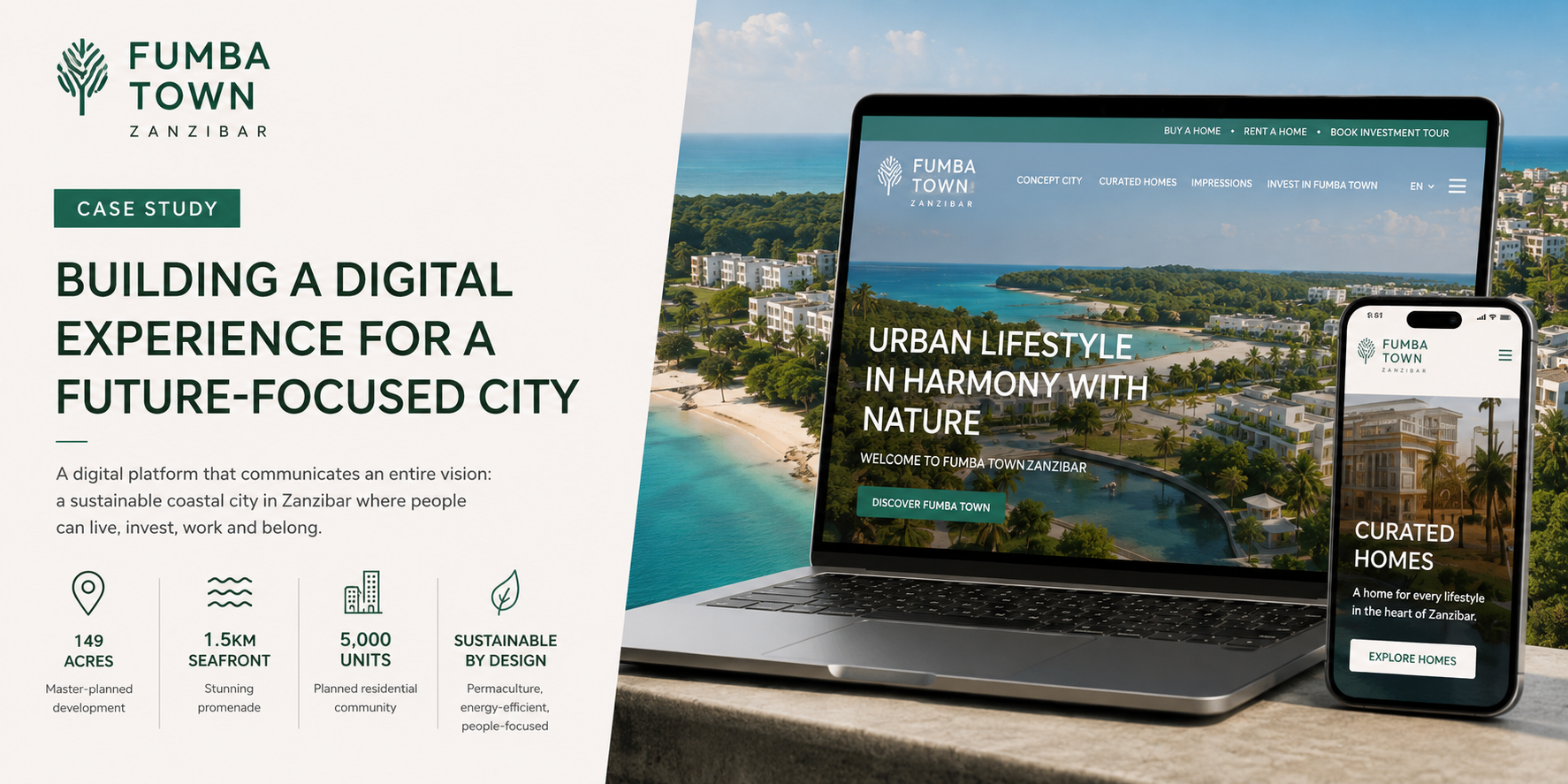
Fumba Town is a master-planned development on the Fumba Peninsula in Zanzibar. Its wider plan covers approximately 149 acres, includes a 1.5-kilometre seafront promenade, and is designed to accommodate around 5,000 residential units. The project combines homes, commercial services, green spaces, leisure facilities, healthcare, workspaces, hospitality, and community infrastructure within one connected destination.
This scale immediately created a more complex digital challenge than that of a standard real-estate website. The platform needed to address several audiences simultaneously:
- international property investors;
- future residents and families;
- expatriates and digital professionals;
- holiday-home buyers;
- tenants;
- commercial and institutional partners;
- visitors exploring Zanzibar as a destination.
Each audience enters the site with a different level of knowledge, risk perception, and purchase intent. The architecture therefore needed to support both emotional discovery and detailed commercial evaluation.
Strategic Challenge
The central challenge was to transform a large and multifaceted urban-development project into a clear digital proposition.
Fumba Town is simultaneously:
- a sustainable city concept;
- a portfolio of residential developments;
- an investment opportunity;
- a lifestyle destination;
- a long-term community;
- a proof point for CPS Africa’s urban-development expertise.
Presenting all of these dimensions without creating confusion required a carefully layered information hierarchy. Visitors first encounter the high-level promise of an urban lifestyle in harmony with nature, then progressively move toward the city concept, home typologies, amenities, investment logic, legal reassurance, and direct enquiry.
Brand Positioning
The digital positioning was built around the idea of a future-facing African coastal city, rather than a gated estate or isolated residential scheme.
The website repeatedly connects four brand pillars:
Urban innovation
Fumba Town is presented as a fully planned city with residential, commercial, leisure, hospitality, and social infrastructure.
Sustainability
Permaculture, energy efficiency, topographic sensitivity, timber construction, and nature-led planning form a core part of the proposition.
Community
The project emphasizes shared amenities, social interaction, public spaces, events, and a diverse international population.
Investment longevity
The city is positioned as a structured, government-supported development with different residential strategies, rental-management options, and long-term growth potential.
This positioning gives the brand a more credible and differentiated identity than a website focused only on ocean views, luxury finishes, and property prices.
Information Architecture
The primary navigation separates the platform into several clear strategic areas:
- Concept City
- Curated Homes
- Impressions
- Invest in Fumba Town
- The Fumba Times
- About CPS Africa
- Zanzibar Facts
- Contact
Dedicated actions for buying a home, renting a home, and booking an investment tour sit alongside the editorial navigation. This is an effective structure because it separates inspiration from transaction while keeping high-value conversion actions continuously accessible.
The architecture effectively supports three user modes:
- Discovery — understanding the destination and lifestyle.
- Evaluation — reviewing housing types, infrastructure, investment fundamentals, and legal conditions.
- Action — enquiring, buying, renting, or booking an on-site investment experience.
Experience and Content Strategy
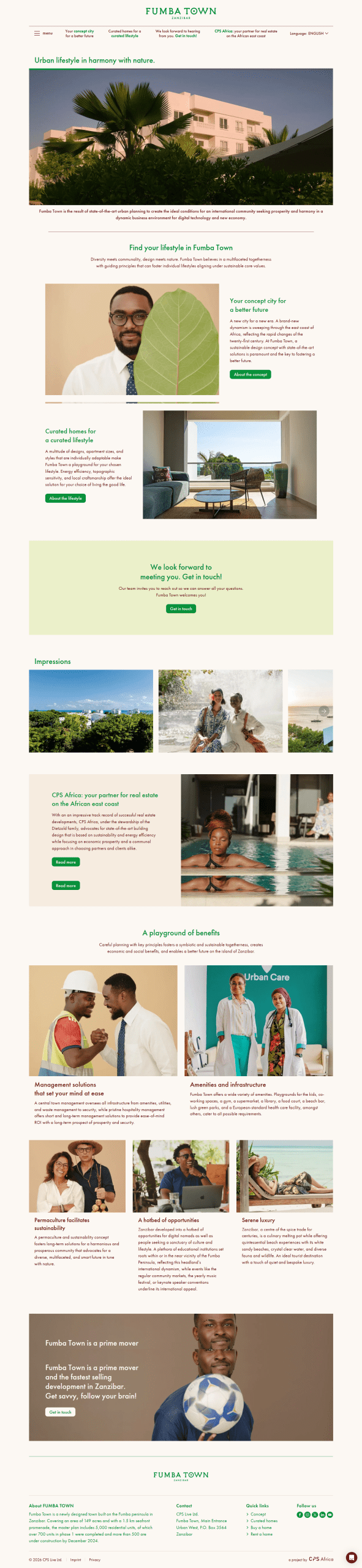
The homepage is structured as a narrative introduction to the town.
It begins with broad lifestyle and city-building messages, then expands into the development’s two central propositions:
- a concept city designed for a better future;
- curated homes designed around different lifestyles.
From there, the user is introduced to images, the developer, the benefits of town management, amenities, permaculture, Zanzibar’s opportunity landscape, and the project’s wider investment case.
This progressive disclosure approach is important. A project of this scale cannot be explained effectively through one hero section or a grid of properties. The site instead builds understanding gradually, allowing users to move from emotional interest to rational confidence.
Curated Residential Portfolio
The Curated Homes section organizes a highly diverse residential portfolio under a common lifestyle framework.
The website presents multiple housing concepts, including:
- CheiChei, combining commercial, communal, and residential uses;
- Soul Fumba, a serviced residential resort;
- Burj Zanzibar, a timber high-rise combining residences and hospitality;
- Vizazi, adaptable timber homes;
- Moyoni Bay, a landscape-led tropical community;
- Bustani Villas, premium ocean-view villas;
- Horizon Villas, contemporary coastal homes;
- Mwangani, garden-based residences;
- Mwangani Skyloft, elevated homes with panoramic views.
From a UX perspective, this creates a portfolio rather than a single-product proposition. Different buyer profiles can identify a suitable development according to budget, lifestyle, usage, or investment strategy.
The section also reinforces the brand’s central idea of “curated living” by focusing on adaptability, design, energy efficiency, local craftsmanship, and connection to nature rather than only square metres and bedroom counts.
Investment Funnel
The investment experience is significantly more advanced than a standard contact page.
The dedicated investment journey introduces Fumba Town as a lifestyle-led, master-planned city and then supports the proposition with:
- development statistics;
- investment rationale;
- project options;
- legal assurances;
- international ownership information;
- guided discovery trips;
- structured lead forms.
The enquiry form captures not only contact details, but also nationality and investment purpose, including rental income, holiday-home use, relocation, mixed lifestyle and investment, or early-stage exploration.
This is strategically useful because it enables lead qualification before sales contact. The sales team can segment users according to intent and adapt its follow-up accordingly.
Lead Generation Strategy
The website operates with several conversion levels.
Primary conversions
- Buy a home
- Rent a home
- Submit an investment enquiry
- Book an investment discovery trip
- Contact the project team
Secondary conversions
- Explore the city concept
- Browse residential typologies
- Review Zanzibar information
- Read editorial content
- Follow the project on social media
- Learn about CPS Africa
This multi-level funnel allows the platform to serve users who are not yet ready to enquire without losing them. Educational and lifestyle content keeps early-stage prospects engaged until they reach a higher level of intent.
Investment Discovery Trips
One of the strongest conversion mechanisms is the Investment Discovery Trip.
Rather than asking overseas buyers to commit based only on digital information, the website promotes a guided physical experience that includes:
- a town visit;
- tours of completed and ongoing projects;
- meetings with legal, financial, and local experts;
- explanations of market demand and rental potential;
- exposure to Zanzibar’s culture and lifestyle.
This reduces perceived investment risk and transforms an abstract property enquiry into an experiential sales process. It is particularly effective for an international development where trust, legal clarity, and first-hand experience are critical to conversion.
Trust and Investor Reassurance
The website uses several layers of reassurance.
First, it presents development progress and scale through measurable figures. The investment section highlights thousands of planned units, homes sold, and units available or completed.
Second, it explains the legal framework, including foreign ownership, residency opportunities, legal security, stamp-duty benefits, and repatriation of post-tax sales proceeds.
Third, it introduces CPS Africa as an experienced development partner focused on sustainability, energy efficiency, economic longevity, and collaboration with local communities and the Zanzibar government.
Together, these elements address the principal barriers faced by international real-estate buyers: legitimacy, ownership security, delivery confidence, and long-term management.
Sustainability Communication
Sustainability is treated as part of the project’s operating logic rather than a superficial marketing claim.
The website references:
- permaculture principles;
- energy-efficient buildings;
- topographic sensitivity;
- local craftsmanship;
- timber-based construction;
- waste and infrastructure management;
- green spaces and walkable neighbourhoods;
- integrated community amenities.
The Burj Zanzibar is used as a highly visible symbol of this direction: a planned 27-storey timber-frame tower combining residences, shops, hospitality, and a rooftop restaurant.
This gives the digital platform a strong architectural and environmental narrative that supports both brand differentiation and investor credibility.
Lifestyle and Destination Marketing
The website does not market homes in isolation. It markets the daily life surrounding them.
The content highlights:
- landscaped gardens;
- ocean access;
- parks;
- playgrounds;
- co-working spaces;
- a gym;
- a supermarket;
- a library;
- a food court;
- a beach bar;
- healthcare;
- community markets;
- cultural and business events;
- access to Zanzibar City, Stone Town, the airport, and educational institutions.
This broadens the value proposition from property ownership to quality of life. It is especially important for buyers considering relocation, second residence, or long-term rental demand.
Multilingual and International UX
The core site supports English and German, reflecting the international nature of its audience.
The investment form also includes extensive nationality selection and purpose-based segmentation. This confirms that the platform is designed for cross-border acquisition rather than only domestic lead generation.
From a technical UX perspective, this international structure supports:
- multiple buyer markets;
- localized sales follow-up;
- overseas lead qualification;
- multilingual content expansion;
- different investment motivations.
Developer Brand Integration
The website also serves as a corporate credibility platform for CPS Africa.
Rather than separating the development completely from the developer, the site connects Fumba Town’s proposition to CPS Africa’s wider philosophy of sustainable urbanism, inclusive development, and long-term investment value.
This strengthens the perceived legitimacy of the project and gives visitors a clear answer to an essential question: who is responsible for delivering and managing the vision?
Technical and Functional Structure
The platform combines several functional layers:
- bilingual content architecture;
- high-impact visual storytelling;
- image galleries and project impressions;
- residential typology pages;
- editorial and news content;
- external buy and rental pathways;
- investment lead forms;
- investor-purpose segmentation;
- discovery-trip booking;
- legal and ownership information;
- social-media integration;
- contact and sales routing;
- developer credibility content.
This modular structure allows the site to function simultaneously as a brand website, property-discovery platform, investor-education resource, destination guide, and sales-acquisition tool.
Marketing Value
The website’s principal strength is its ability to unite place branding and commercial property marketing.
It creates value at several levels:
- builds international awareness for Fumba Town;
- establishes Zanzibar as a credible lifestyle and investment destination;
- differentiates the project through sustainability and urban planning;
- explains a complex residential portfolio;
- qualifies leads according to investment intent;
- drives home sales and rental enquiries;
- promotes physical investment tours;
- supports developer trust;
- nurtures early-stage prospects through content;
- reinforces long-term community and destination positioning.
Outcome
The resulting platform positions Fumba Town not simply as a collection of homes, but as a complete urban proposition.
It gives visitors a structured path from inspiration to decision:
Discover Zanzibar → understand the city vision → explore lifestyles and homes → assess investment potential → review legal confidence → enquire, visit, buy, or rent.
The website therefore operates as a destination-branding platform, international investor funnel, residential portfolio, and long-term urban-development narrative.
Key points of the project
- Master-planned city positioning
- International real-estate platform
- Sustainable-development storytelling
- Curated residential portfolio
- Investment lead qualification
- Direct buy and rent pathways
- Discovery-trip conversion funnel
- Legal and investor reassurance
- Lifestyle and destination marketing
- Multilingual user experience
- Community and amenity presentation
