



ESPACIO The Jewel of Waikiki – Hostel Website
Building an ultra-luxury hospitality platform around privacy, personalisation and exceptional service
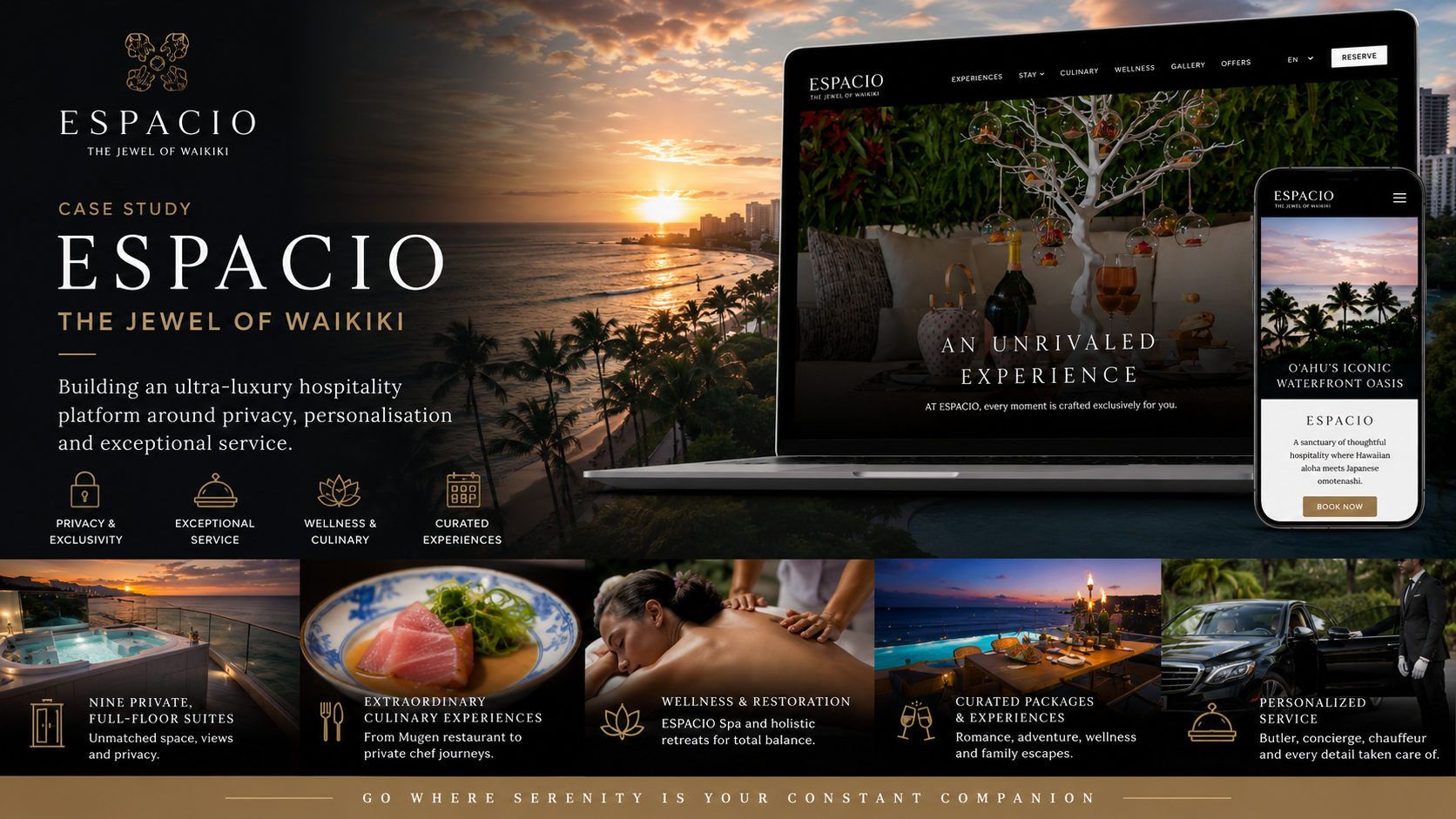
ESPACIO The Jewel of Waikiki is an exclusive oceanfront hotel in Honolulu built around a highly differentiated hospitality model: just nine private, full-floor suites overlooking Waikiki Beach. The property combines residential-scale accommodation with butler service, private transportation, fine dining, spa experiences and carefully curated island itineraries.
Our objective was to translate this rare level of privacy and personal service into a digital experience that feels equally considered. The website needed to communicate exclusivity without becoming distant, present a complex luxury offer without overwhelming the visitor, and guide high-intent travellers smoothly from inspiration to reservation.

The Challenge
ESPACIO is not a conventional luxury hotel. Its proposition is closer to a private residence supported by five-star hotel services. Each suite occupies an entire floor, while the guest experience extends far beyond accommodation through butler service, concierge support, chauffeur-driven transportation, private dining, wellness and bespoke experiences.
The central challenge was therefore one of positioning. The website had to explain why ESPACIO is fundamentally different from a standard Waikiki resort while preserving the restraint expected from an ultra-luxury brand.
It also needed to address several distinct guest motivations:
- privacy and discretion;
- oceanfront accommodation;
- exceptional service;
- culinary discovery;
- wellness and restoration;
- romantic or celebratory travel;
- family experiences;
- complete, low-friction trip planning.
The digital journey had to bring these elements together as one coherent hospitality ecosystem rather than a collection of disconnected amenities.
Strategic Approach
Our strategy centred on three principles: exclusivity, immersion and reassurance.
The homepage opens with an emotional destination proposition—“Oahu’s Iconic Waterfront Oasis”—before introducing the deeper brand promise of Hawaiian aloha combined with Japanese omotenashi. This provides both atmosphere and meaning: the property is positioned not simply as luxurious, but as deeply attentive and service-led.
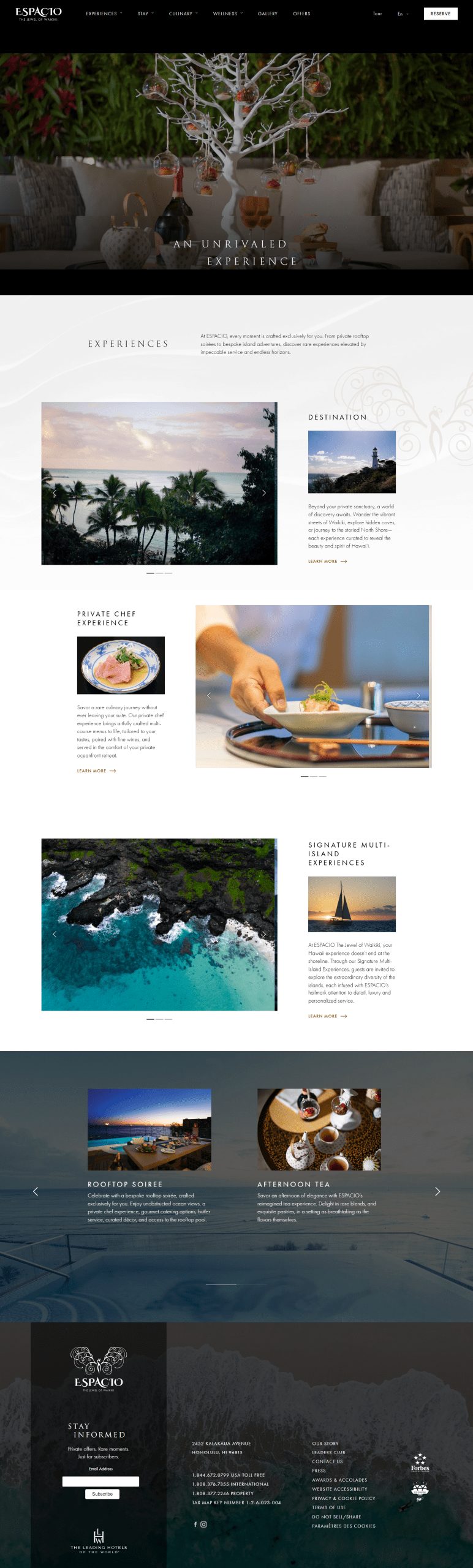
The content hierarchy then progresses through the full guest journey:
- establish the destination and brand atmosphere;
- introduce the nine full-floor suites;
- explain the private services included with the stay;
- present culinary and wellness experiences;
- promote curated packages and special offers;
- move the visitor toward reservation.
This structure allows the website to sell the emotional value of ESPACIO before introducing practical booking decisions.
Suite Discovery and Accommodation Architecture
The accommodation experience is organised by floor level and view category, making a distinctive building structure easy to understand.
The website presents four principal suite experiences:
- Penthouse Diamond Suite;
- Oceanfront Suites;
- Ocean View Suites;
- Beach View Suites.
Rather than reducing the rooms to a list of technical specifications, each category is positioned through its atmosphere and relationship with Waikiki. The Penthouse focuses on panoramic views and elevated exclusivity. Oceanfront Suites emphasise direct Pacific vistas and privacy. Ocean View Suites create a calmer sanctuary, while Beach View Suites connect guests more closely with the energy of the shoreline.
This editorial approach helps prospective guests select according to experience, not merely room type.
Communicating the Full Value of the Stay
One of the most important strategic tasks was to make the extensive list of included services feel like a unified luxury proposition.
ESPACIO guests receive access to features such as:
- a private elevator and entryway;
- a furnished balcony with private Jacuzzi soaking tub;
- a gourmet kitchen;
- daily breakfast and in-suite dining;
- butler and 24-hour concierge services;
- a chauffeur-driven Mercedes house car;
- round-trip luxury airport transportation;
- complimentary valet parking;
- museum admission;
- spa-inspired bathrooms;
- sauna access;
- housekeeping and evening turndown service;
- no resort fees.
The website positions these elements as part of the core stay rather than optional extras. This supports price perception by showing that ESPACIO offers a complete private-hospitality environment, not simply premium accommodation.
Service-Led Brand Positioning
ESPACIO’s differentiator is not scale; it is attention.
The site therefore makes service visible throughout the experience. Butler support, concierge itinerary planning, transportation and private services are treated as central parts of the brand. The digital tone avoids transactional hotel language and instead focuses on personalisation, anticipation and care.
The combination of Hawaiian hospitality and omotenashi gives the property a distinctive service philosophy. It communicates warmth, precision and an ability to anticipate guest needs without intrusion.
This helped us position the brand as intimate and highly attentive rather than simply expensive.
Culinary Experience
The culinary section introduces Mugen as a core destination within the property. The restaurant is presented through rare ingredients, highly crafted dishes, Japanese influences and island sensibility.
From a marketing perspective, this expands the value of the hotel. ESPACIO becomes more than a place to stay: it becomes a culinary destination capable of supporting romantic escapes, gastronomic travel and celebratory occasions.
The website also connects Mugen with private chef experiences and selected packages, creating natural cross-selling opportunities between accommodation, dining and special experiences.
Wellness and Private Retreat Positioning
The wellness experience is framed around privacy and individual restoration.
ESPACIO Spa is described as a sanctuary above the ocean, with personalised treatments using carefully selected botanicals and island minerals.
This positioning avoids presenting the spa as a conventional hotel facility. Instead, it becomes part of the property’s wider promise of seclusion, balance and highly tailored care.
The private rooftop further supports this strategy by extending wellness and dining into exclusive sunset experiences, yoga sessions, Champagne and caviar moments and private gatherings.
Curated Packages and Experience Marketing
The offers section converts the property’s services into clear, emotionally driven travel scenarios.
Examples include:
- Renew at ESPACIO, combining massage and a sunset rooftop Champagne and caviar experience;
- Romance in Waikiki, combining treatments, rooftop dining and a paired dinner at Mugen;
- ESPACIO Indulgence, centred on fine dining and sunset hospitality;
- Holistic Harmony Wellness Retreat, with yoga, detox dining and massage;
- Ocean Odyssey Family Adventure, built around private diving, snorkelling and family discovery;
- a cosmetic retreat developed with Asia Pacific Aesthetics.
These packages reduce decision friction for visitors who are interested in the hotel but have not yet defined their stay. Instead of asking guests to assemble every component individually, the website provides curated reasons to book.
UX and Conversion Strategy
The booking journey needed to remain accessible without compromising the visual sophistication of the brand.
Reservation calls to action are distributed across the experience, while suite pages, offers and service sections create several natural entry points into the booking engine. The website also separates hotel and restaurant reservations, recognising that accommodation and Mugen attract overlapping but distinct audiences.
The booking interface captures the essential information:
- check-in date;
- check-out date;
- number of guests;
- number of suites.
This keeps the initial interaction focused and avoids introducing unnecessary complexity at the moment of conversion.
International Audience and Localisation
ESPACIO serves a global luxury audience, so the website supports English, Japanese and Korean versions.
This multilingual structure is strategically important for Waikiki, where international demand forms a substantial part of the luxury hospitality market. It also supports the brand’s cultural positioning by making the experience more accessible to key traveller segments without diluting its identity.
Visual and Editorial Direction
The visual system reflects the property’s positioning through cinematic ocean imagery, refined typography, generous spacing and restrained interaction.
Large-scale photography communicates the location and physical quality of the suites, while the editorial copy avoids generic resort claims. The language focuses on private sanctuaries, panoramic views, curated interiors, personalised service and exceptional experiences.
The result is a website that feels more like a private invitation than a conventional hotel catalogue.
Trust and Prestige
For an ultra-luxury property, trust is built through both tangible detail and external recognition.
The site supports credibility through transparent service inclusions, detailed suite categories, clear contact information and affiliation with The Leading Hotels of the World. It also displays the Forbes Travel Guide Five-Star Award for 2026.
These elements reassure high-value travellers that the promise of exclusivity is supported by recognised hospitality standards.
Result
The result is a refined, immersive and conversion-oriented hospitality platform that presents ESPACIO as a complete private luxury experience.
The website successfully brings together:
- full-floor suite discovery;
- personalised service;
- private transportation;
- culinary excellence;
- wellness;
- curated packages;
- international accessibility;
- direct reservation pathways.
Rather than positioning ESPACIO as another luxury hotel in Waikiki, the digital experience defines it as a private waterfront residence where every element of the stay can be personally orchestrated.

Key points of the project
- Luxury hospitality website strategy
- Premium brand positioning
- UX and information architecture
- Suite-category presentation
- Booking-journey optimisation
- Service and amenity storytelling
- Culinary and wellness positioning
- Experience-package marketing
- International localisation strategy
- Conversion-focused hospitality content hierarchy