



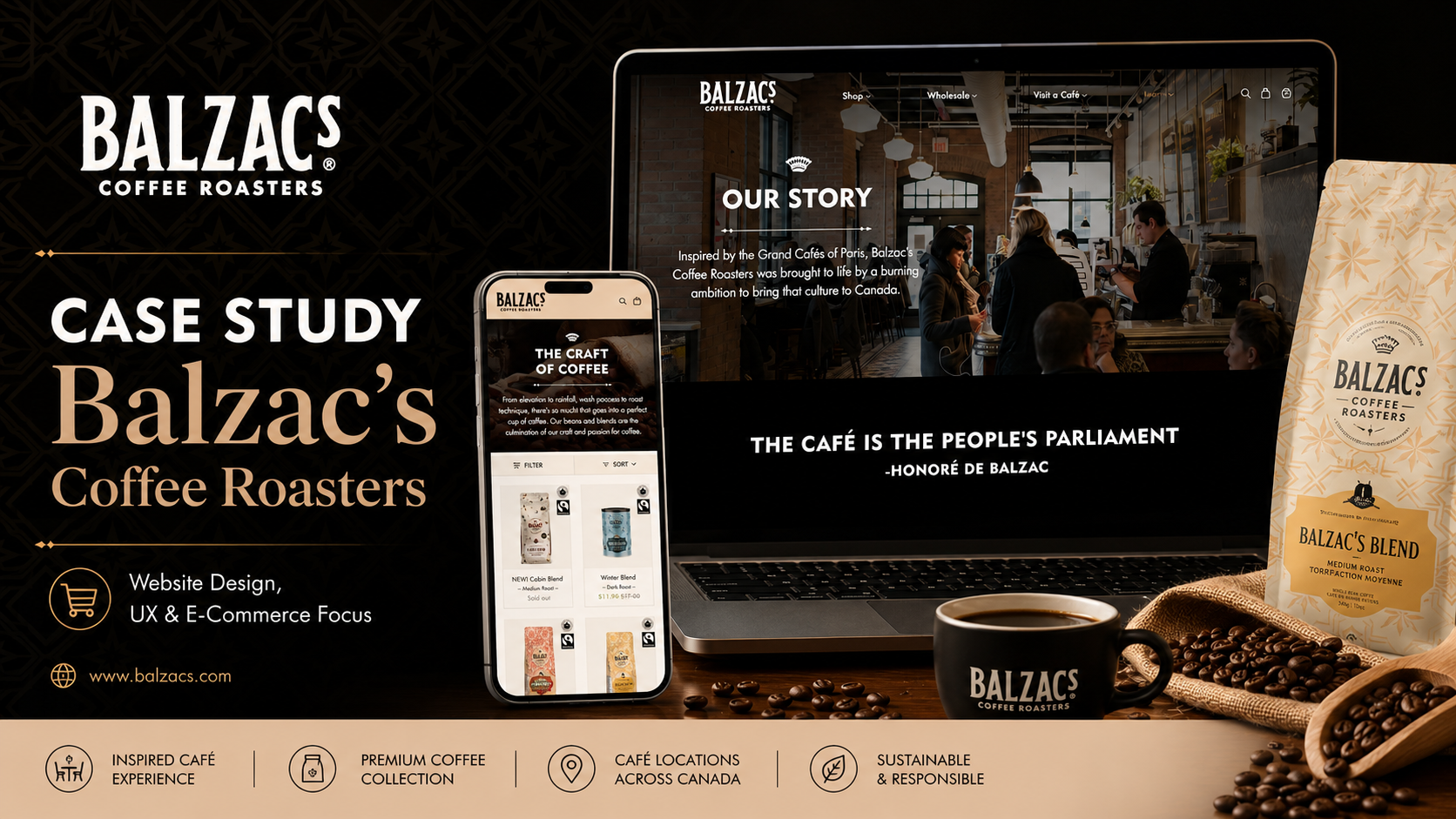
Balzac’s Coffee Roasters – Website
Creating a Premium E-Commerce & Brand Platform for a Canadian Coffee Roaster
Balzac’s Coffee Roasters is a Canadian coffee brand inspired by the grand cafés of Paris. The brand started as a coffee cart in 1993, opened its first café in Stratford, Ontario in 1996, and has since grown into 16 distinct café locations, with products also available in grocery stores across Canada.
The website had to serve several goals at once: sell coffee online, promote café visits, communicate the brand story, support wholesale growth, and reinforce Balzac’s premium positioning. For a coffee brand with both retail and physical café experiences, the digital platform needed to feel elegant, editorial, and commercially efficient.

Project Context
Balzac’s is not positioned as a generic coffee retailer. Its identity is built around craft, culture, literary references, café heritage, and a strong sense of place. The website therefore needed to combine e-commerce functionality with brand storytelling.
The navigation reflects this dual purpose clearly: users can shop coffee and gift cards, explore wholesale, find a café, view the café menu, learn about the story and sustainability, read news and recipes, or contact the brand.
This creates a platform that supports several audiences:
Consumers buying coffee online.
Local visitors looking for a café.
Wholesale partners interested in carrying the brand.
Coffee lovers exploring recipes, sustainability and brand culture.
Job seekers and community members engaging with the company.
Challenge
The first challenge was balancing commerce and brand atmosphere. Coffee e-commerce needs clear product discovery, filtering, cart access, account features and checkout. But Balzac’s also has a strong cultural identity, so the site could not feel like a purely transactional online store.
The second challenge was organizing multiple business channels. Balzac’s operates through online coffee sales, cafés, wholesale, grocery distribution, gift cards, recipes and community content. The website needed to make these areas accessible without making the user journey feel heavy or fragmented.
The third challenge was communicating quality and craft. The coffee collection introduces the idea of “The Craft of Coffee,” explaining that elevation, rainfall, wash process and roast technique all contribute to the final cup. Product filters allow users to browse by bean type, roast type and certifications such as Fairtrade and Organic.
Strategy
Our strategy focused on building a website experience around three pillars: premium product discovery, café culture, and brand credibility.
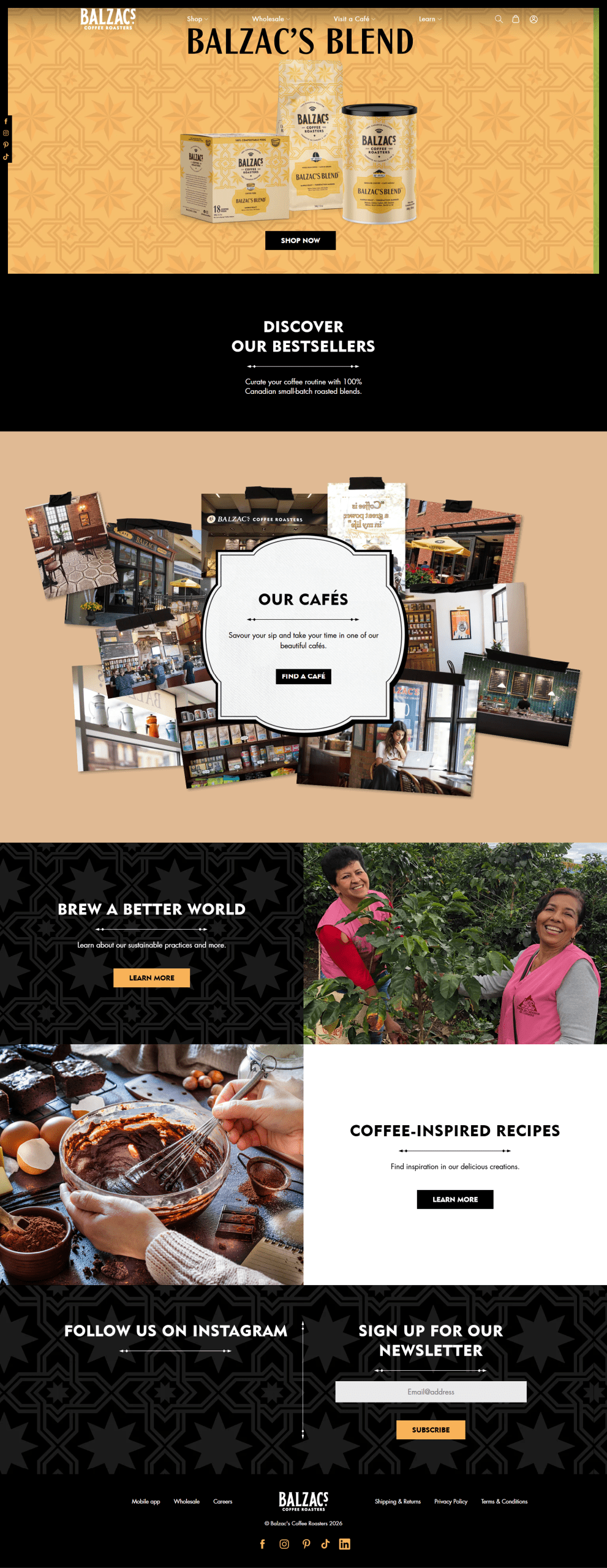
The homepage gives users direct entry points into the brand ecosystem: shopping bestsellers, finding a café, learning about sustainable practices, exploring recipes and signing up for the newsletter.
The e-commerce experience is designed to support both quick purchasing and considered browsing. Visitors can shop whole bean, ground coffee, single serve and all coffee products, while filters help narrow the catalog by roast, bean type and certification.
The brand story page strengthens emotional positioning by connecting Balzac’s to the tradition of Parisian grand cafés and the idea of cafés as gathering places for conversation, creativity and community.
UX & Content Approach
The website structure is clear and commercially practical. The main navigation separates the experience into four major user intents:
Shop — coffee and gift cards.
Wholesale — become a wholesaler or find a retailer.
Visit a Café — café locations and café menu.
Learn — story, sustainability, news, recipes, jobs and contact.
This structure works well because it respects how different audiences arrive on the site. A returning customer can go directly to coffee. A local visitor can find a café. A business buyer can enter through wholesale. A brand-curious visitor can explore the story.
The content tone is refined and distinctive. Product descriptions are not purely technical; they use narrative language that fits the literary and café-inspired identity of the brand. For example, Balzac’s Blend is described as bold, rounded and generous, while Bards Blend references William Shakespeare.
E-Commerce Experience
The shop experience is built around accessibility and conversion. The coffee collection includes 15 products and lets visitors filter by single origin, blends, dark roast, medium roast, Fairtrade and Organic certifications.
The cart system reinforces purchase intent with a clear free-shipping message: customers are encouraged to buy $50 CAD or more to qualify for free shipping in Canada.
The website also includes account creation, login, wishlist functionality and cart checkout, supporting repeat purchasing — a key requirement for a coffee brand where recurring orders and customer loyalty matter.
Visual & Brand Direction
The website’s visual direction reflects the brand’s premium café positioning. Rather than relying only on product grids, the site uses large imagery, editorial sections and brand-led content blocks to create a more immersive experience.
The design supports several brand associations:
Craft — through coffee education and product detail.
Culture — through the Parisian café inspiration and literary references.
Community — through café locations, social media and local gathering-place messaging.
Quality — through premium product presentation and clear product categorization.
The result is a website that feels more like a modern specialty coffee brand than a standard online shop.
Content & Storytelling
Balzac’s uses storytelling as a strategic differentiator. The “Our Story” page explains that the brand was inspired by the grand cafés of Paris and built around a desire to bring that culture to Canada. It also emphasizes that each café is designed to reflect the cultural nuances and historical significance of its location.
This is important because it gives the brand depth. The cafés are not presented as identical retail units; they are positioned as local gathering places with individual personalities.
The homepage also extends the storytelling system with sections dedicated to cafés, sustainability and coffee-inspired recipes.
Conversion Approach
The website uses several conversion pathways depending on user intent:
Shop Now for coffee purchases.
Find a Café for local visits.
Learn More for sustainability and recipes.
Newsletter signup for retention.
Wholesale entry points for B2B growth.
Cart, wishlist and account tools for repeat e-commerce behaviour.
This multi-path approach is especially relevant for Balzac’s because the brand monetizes through both physical and digital touchpoints. The site does not force every user into the same funnel; it allows each visitor to move toward the most relevant action.
Business Impact
The final website positions Balzac’s Coffee Roasters as a premium coffee brand with a strong Canadian footprint, a refined e-commerce experience, and a clear café culture narrative.
It supports direct-to-consumer coffee sales, café discovery, wholesale opportunities, content marketing and brand loyalty. The combination of product commerce and editorial storytelling helps the brand sell coffee while preserving the atmosphere that makes Balzac’s distinctive.
Result
The Balzac’s website successfully bridges specialty coffee retail, café experience and brand storytelling. It gives users a clear way to shop online, find a café, explore the brand’s history, discover recipes and engage with the company beyond a single purchase.
The result is a polished, conversion-ready digital platform that reflects the brand’s identity: cultured, craft-focused, Canadian and rooted in the timeless appeal of café life.

Key points of the project
- Premium coffee e-commerce
- Café discovery journey
- Strong brand storytelling
- Parisian café inspiration
- Product filtering system
- Wholesale growth pathway
- Newsletter retention
- Sustainability content
- Recipe-driven engagement
- Multi-channel conversion
