



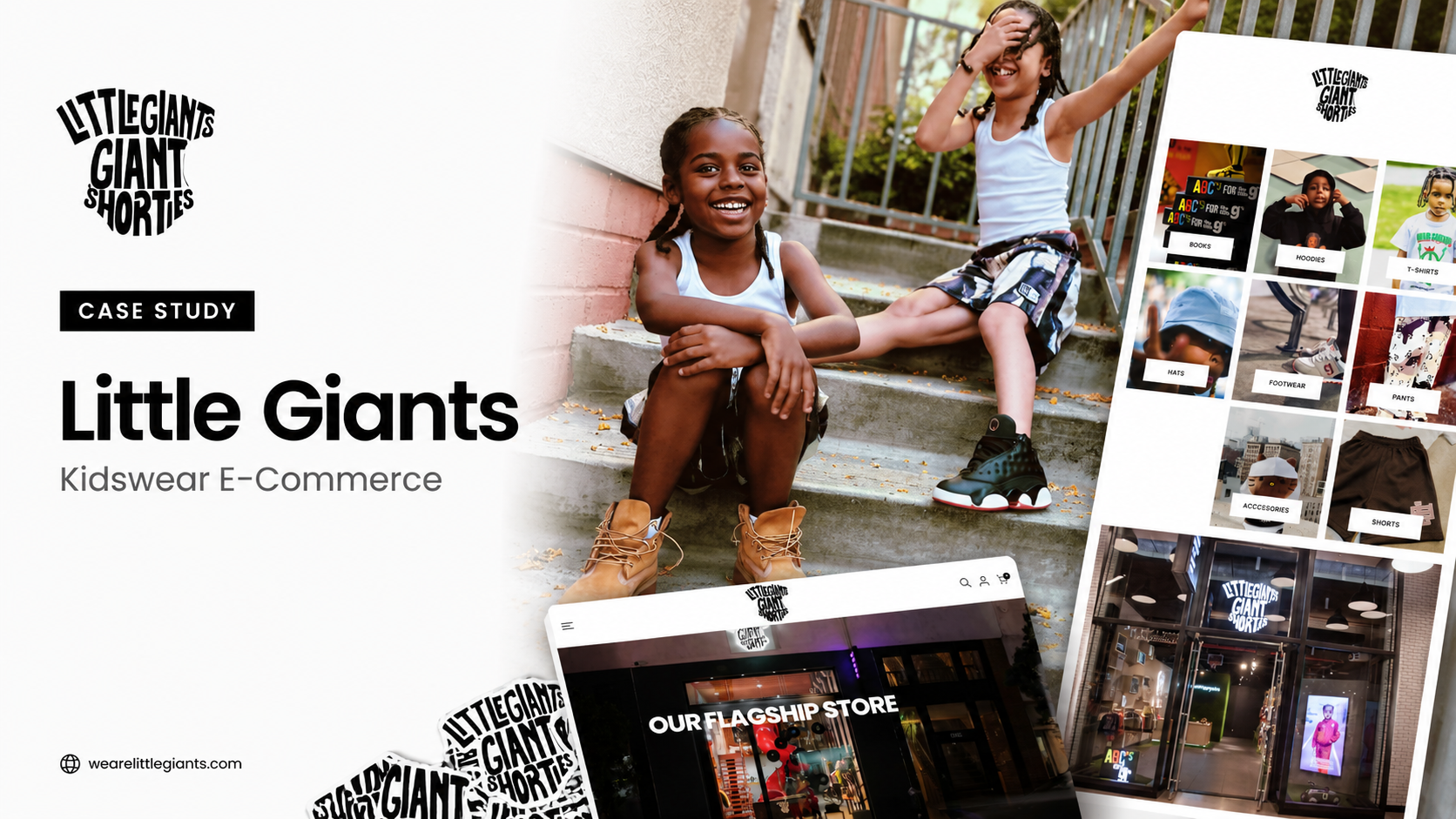
Little Giants – Kids’ Streetwear E-commerce
Building a Culture-Driven E-Commerce Platform for a Distinctive Kids’ Streetwear Brand
Little Giants is an independent children’s streetwear brand created for parents who reject conventional kidswear and want clothing that reflects the same culture, attitude, and visual language they value themselves.
The brand combines the unapologetic DIY energy of streetwear with the playful, rebellious nature of childhood. Its product universe spans T-shirts, hoodies, onesies, hats, shorts, outerwear, footwear, accessories, books, collectibles, and gift cards, all developed through a culturally specific point of view rather than a generic children’s-fashion formula.
The website therefore needed to achieve more than displaying products. It had to preserve Little Giants’ independent voice, support a large and varied catalogue, make product discovery easy, and turn cultural affinity into purchases and long-term community engagement.

Project Context
Little Giants was born from a personal need. The founders began creating one-off pieces for their son because they could not find baby and children’s clothing that reflected their own streetwear influences and cultural interests. Demand from friends, parents, and peers gradually transformed those early pieces into a family-run brand.
That origin story is central to the project. The brand is not attempting to imitate adult streetwear for children as a superficial trend. It is built from within the culture and speaks directly to parents who share that background.
The website needed to communicate three things immediately:
- this is not conventional childrenswear;
- the brand has a clear cultural identity;
- the products are designed with the same attention and personality as adult streetwear.
The homepage distils this proposition into the recurring statement “Better Goods for Great Kids,” supported by direct shopping calls to action and immediate access to key product categories.
The Challenge
1. Preserving authenticity while improving usability
Little Giants has a strong, informal tone of voice. Its language is opinionated, direct, playful, and rooted in hip-hop, streetwear, youth culture, and family life.
The challenge was to retain that personality without allowing the user experience to become chaotic or difficult to navigate. The site needed a clear commercial structure while still sounding unmistakably like Little Giants.
2. Organising a broad product catalogue
The store covers a substantial catalogue across several collections, including hundreds of T-shirts and hoodies alongside onesies, hats, books, accessories, pants, shorts, footwear, outerwear, and gift cards.
A large inventory creates several UX risks:
- visitors can struggle to understand the full range;
- product discovery can become overwhelming;
- repeat customers may find it difficult to locate new releases;
- limited-edition products can become buried;
- parents need to identify suitable sizes quickly.
The website therefore required strong category architecture, filtering, sorting, search, and clear product-page information.
3. Serving both parents and culture-conscious shoppers
The buyer is usually an adult, but the product must still feel energetic and relevant to children. The website had to balance adult purchasing confidence with the visual attitude of the brand.
Parents need practical details such as size ranges, availability, price, shipping, and product specifications. At the same time, the brand cannot lose the wit and cultural references that make its products desirable.
4. Converting a brand community into customers
Little Giants operates as more than a retail catalogue. The language of “the crew,” limited releases, collectible products, Instagram content, and newsletter access all support a sense of belonging.
The website needed to convert this community energy into measurable commercial actions:
- product browsing;
- newsletter subscriptions;
- first purchases;
- repeat purchases;
- store visits;
- social engagement.
Strategic Approach
Our digital strategy centred on five principles: culture, clarity, discovery, scarcity, and community.
Culture-led brand positioning
The site presents Little Giants as a children’s streetwear brand with a genuine point of view, not a mass-market fashion label.
The About content openly states that the brand makes modern goods for children inspired by youth cultures past and present, and that the founders create clothes for their children that they would want to wear themselves.
This gives the brand an unusually clear identity. Rather than attempting to appeal to every parent, the website speaks confidently to a culturally aligned audience.
Product-first commerce
The homepage keeps the commercial objective visible from the outset through direct actions such as Shop Now, See More, and Check Us Out. Best-selling categories are surfaced quickly, allowing visitors to move directly from brand discovery into shopping.
The experience does not bury the store behind a long lifestyle narrative. Brand personality and commerce work together.
Scalable collection architecture
The catalogue is organised into dedicated collections, including:
- T-shirts
- Hoodies
- Onesies
- Hats
- Books
- Footwear
- Pants
- Shorts
- Accessories
- Outerwear
- Gift cards
This structure gives shoppers several clear entry points and creates scalable landing pages for search visibility and seasonal merchandising.
Limited-edition and collector positioning
Selected products are framed as special editions or collector’s items, with defined size runs and limited availability. For example, some designs are produced across sizes from six months to 11–12 years and remain available only while supplies last.
This introduces urgency without relying exclusively on discounts. Scarcity becomes part of the brand experience.
Community and retention
The newsletter offer gives first-time subscribers 15% off while using brand-specific language such as “Welcome to the Crew.” This makes email acquisition feel like joining a community rather than completing a generic promotional form.
Instagram is also positioned as a core extension of the brand, reinforcing discovery, launches, styling inspiration, and cultural relevance.
UX & Information Architecture
The website is structured around the main behaviours of an e-commerce customer.
Discover
The homepage introduces the brand proposition, presents promotional imagery, and highlights best-selling categories.
Browse
Visitors can enter the catalogue through specific product collections or view the complete product range.
Refine
Collection pages provide sorting options including:
- featured;
- best selling;
- alphabetical order;
- price;
- publication date.
These tools are essential for a catalogue with a large number of products.
Evaluate
Product pages provide:
- price;
- available sizes;
- stock status;
- product description;
- artwork placement;
- edition information;
- additional product details;
- reviews;
- stock notifications.
This helps balance the brand’s expressive tone with the practical reassurance required before purchase.
Purchase
The shopping cart includes shipping estimation, coupon entry, order notes, subtotal visibility, and checkout access. It also communicates that charges are processed in USD.
Brand Voice & Content Strategy
Little Giants’ voice is one of its strongest differentiators.
The copy does not sound like conventional childrenswear marketing. It uses humour, slang, cultural references, and deliberately opinionated statements. Phrases such as “Better Goods for Great Kids,” “Being on the list is lit,” and “Soccer moms won’t like us and that’s peace” establish a highly specific identity.
From a marketing perspective, this works because the language performs several functions simultaneously:
- filters for the intended audience;
- makes the brand memorable;
- increases emotional affinity;
- creates shareable moments;
- gives product names more personality;
- reinforces independence from mainstream kidswear.
The content strategy also connects products with broader cultural themes through names and concepts related to identity, resistance, creativity, music, cities, education, and social commentary.
Product Strategy
The product range extends beyond basic apparel.
Alongside T-shirts, hoodies, and onesies, the store includes board books, art figures, cups, outerwear, caps, footwear, and other accessories. Examples include alphabet and number books, culturally themed children’s books, collectible figures, and lifestyle items.
This broader catalogue serves several strategic purposes:
- increases average order potential;
- expands gifting opportunities;
- positions the brand as a cultural universe rather than a clothing label;
- gives customers more reasons to return;
- supports product collaborations and limited drops;
- allows the brand to reach children at different ages.
The product pages also accommodate broad age ranges, helping the brand remain relevant from infancy into later childhood.
Visual Direction
The visual approach supports the energy of streetwear rather than the softness usually associated with children’s retail.
The site relies on:
- bold graphic designs;
- strong campaign imagery;
- product-led compositions;
- cultural references;
- direct typography;
- high-contrast layouts;
- informal language;
- visually distinct collections.
This creates a deliberate contrast with traditional baby and children’s clothing websites, which often rely on pastel colours, sentimental imagery, and generic family messaging.
Little Giants instead communicates confidence, humour, individuality, and cultural literacy.
E-Commerce Conversion Strategy
The website combines several conversion mechanisms.
Immediate shopping actions
The homepage repeatedly invites users to enter the store through direct CTAs and best-selling product categories.
Collection-based discovery
Visitors can shop by product type instead of navigating one undifferentiated catalogue.
Product scarcity
Limited quantities, special editions, out-of-stock notifications, and collector positioning create urgency and encourage faster decisions.
Email acquisition
A 15% first-order incentive helps turn anonymous visitors into identifiable prospects while supporting future launch and lookbook communication.
Search and sorting
Search and multiple sorting options reduce friction for returning shoppers or users looking for a particular type of product.
Cross-category purchasing
The breadth of apparel, books, accessories, and collectibles creates opportunities for multi-product baskets and gifts.
Physical Retail Integration
The digital platform also supports the brand’s physical presence.
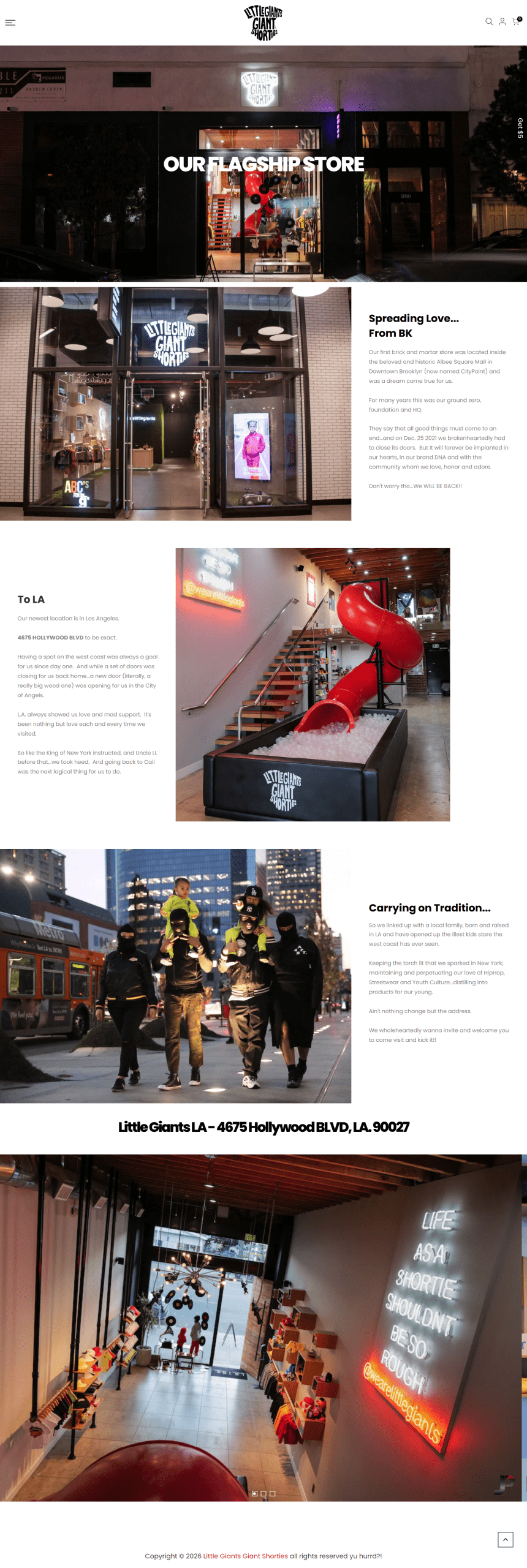
Little Giants operates a Los Angeles flagship location at 4675 Hollywood Boulevard. The store is described as a continuation of the brand’s relationship with hip-hop, streetwear, and youth culture, translated into a dedicated physical space for children and families.
The flagship page strengthens the brand by:
- giving online customers a real-world destination;
- reinforcing cultural credibility;
- supporting local search and store visits;
- providing a location for community interaction;
- connecting digital launches with in-store experiences.
This creates a stronger omnichannel model than a purely online store.
SEO & Organic Discovery
The website’s collection structure creates valuable search entry points for high-intent queries around children’s streetwear.
Relevant themes include:
- kids streetwear;
- toddler streetwear;
- children’s graphic T-shirts;
- kids hoodies;
- baby streetwear;
- culturally relevant children’s clothing;
- hip-hop clothing for kids;
- streetwear books for children;
- independent kids fashion;
- limited-edition children’s apparel.
Dedicated collection pages, individual product descriptions, size information, and category-specific metadata allow the brand to target both broad and long-tail purchase intent.
The About and flagship content also support branded search, local discovery, and editorial storytelling.
Why the Website Works
The site succeeds because it does not separate the brand’s cultural identity from the shopping experience.
Its strongest strategic qualities are:
- a highly distinctive tone of voice;
- immediate access to commerce;
- scalable product categorisation;
- limited-edition product urgency;
- a catalogue extending beyond apparel;
- practical product and size information;
- community-oriented newsletter language;
- integration of online and physical retail;
- strong potential for organic product discovery.
The result is an e-commerce experience that feels specific, independent, and culturally credible.
Result
The final platform positions Little Giants as more than a children’s clothing store.
It presents the brand as a family-founded streetwear and culture platform for parents who want their children’s clothing to carry identity, humour, attitude, and meaning.
The website supports the full customer journey:
- discovering the brand;
- understanding its philosophy;
- browsing a large catalogue;
- filtering and comparing products;
- choosing appropriate sizes;
- purchasing limited releases;
- joining the email community;
- following the brand socially;
- visiting the Los Angeles flagship.
The outcome is a commercially scalable e-commerce platform that protects Little Giants’ independent voice while making its expanding product universe easier to discover and purchase.

Key points of the project
- Culture-driven kidswear positioning
- Distinctive streetwear identity
- Large scalable catalogue
- Clear collection architecture
- Limited-edition product strategy
- Strong community language
- Newsletter-led retention
- Physical retail integration
- Broad size-range support
- Product and culture ecosystem
