


OpenAI’s own Ads site frames the opportunity clearly: advertisers can reach people while they “explore options, compare choices, and make decisions” inside ChatGPT, with ads designed to fit naturally into the experience. The company also positions ChatGPT ads as a way to go beyond keyword targeting by using richer contextual signals from user conversations.
From pilot to platform
The strategic importance of Ads Manager is that it turns ChatGPT advertising from a controlled pilot into something closer to a scalable ad product.
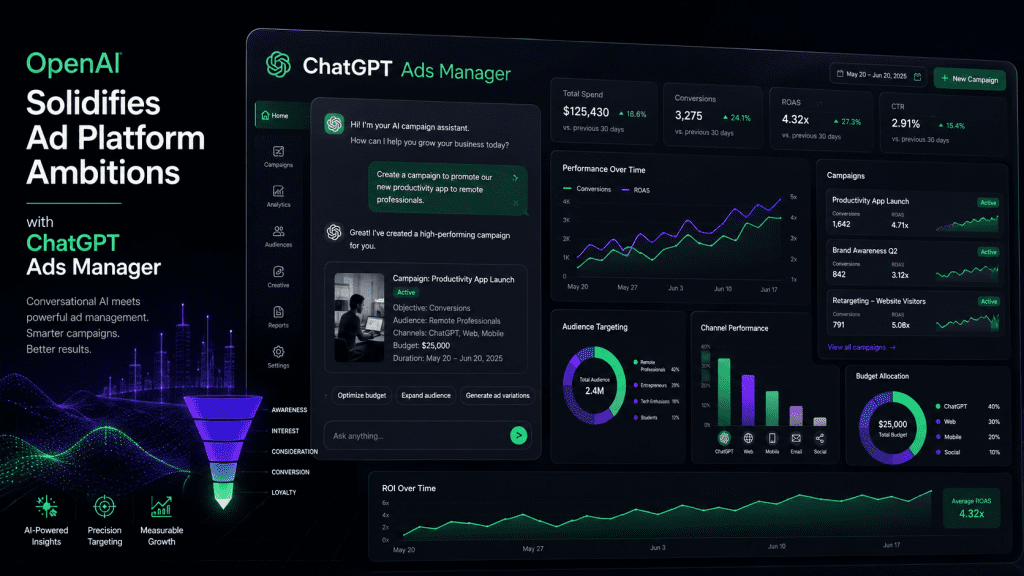
OpenAI’s Help Center describes Ads Manager Beta as a platform to create, launch and manage campaigns in ChatGPT Ads, with performance monitoring and campaign updates in one place. Current workflows include campaign creation, bulk upload, reporting on impressions, clicks and spend, CSV exports, account settings, permissions, billing details and change logs.
That matters because self-serve infrastructure is what turns advertising into a platform business. It gives brands and agencies the operational tools they expect: budget control, campaign management, performance visibility and repeatable workflows.
Marketing Dive reported that OpenAI is expanding its ads pilot with a beta self-serve Ads Manager for U.S. businesses, while introducing cost-per-click bidding and expanded measurement tools. The report also notes that advertisers can set budgets, upload ads, launch campaigns, manage performance and view results through the portal.
Why ChatGPT ads are different
OpenAI is not simply copying search ads or social ads. The company is trying to create an ad environment around decision-stage conversations.
That is the core difference. Search ads are built around queries. Social ads are built around interests, identity signals and content consumption. ChatGPT ads could be built around active problem-solving: users comparing products, asking for recommendations, planning purchases, evaluating options or trying to complete a task.
For advertisers, this could become valuable because intent inside ChatGPT may be more explicit and structured than a normal browsing session. A user asking “What is the best CRM for a small agency?” or “Which laptop should I buy for video editing?” is not just consuming content; they are moving toward a decision.
The business logic is obvious
OpenAI needs large, durable revenue streams to support the cost of building and operating advanced AI systems. Advertising offers scale that subscriptions alone may not deliver.
Reuters reported, citing Axios, that OpenAI expects to generate $2.5 billion in advertising revenue this year and potentially reach $100 billion by 2030, based on investor presentation assumptions. Reuters also reported that OpenAI’s U.S. ads pilot had crossed $100 million in annualized revenue within six weeks and had expanded to more than 600 advertisers.
Those numbers suggest that advertising is not a secondary experiment. It is becoming part of OpenAI’s long-term monetization architecture.
The trust challenge
The opportunity is huge, but so is the risk.
ChatGPT’s value depends heavily on user trust. If ads feel intrusive, manipulative or indistinguishable from answers, OpenAI could damage the product experience that made ChatGPT successful in the first place.
OpenAI appears aware of this. Its Ads page states that ads are clearly identified, remain distinct from ChatGPT’s responses, and that users have control over how their data is used for ads.
That separation will be critical. The more ChatGPT becomes a decision engine, the more users will need confidence that recommendations are not secretly shaped by advertisers.
What this means for marketers
For brands, ChatGPT Ads Manager could become a new acquisition channel alongside Google, Meta, TikTok, Amazon and retail media networks.
But the playbook will not be identical. Winning on ChatGPT may require content and offers built for conversational discovery: clear product positioning, useful comparisons, strong landing pages, trustworthy proof points, structured product data and post-click measurement.
The most prepared advertisers will likely be those that already have:
strong product feeds;
clear value propositions;
high-converting landing pages;
clean analytics and conversion tracking;
CRM integrations;
content that answers real customer questions;
a test-and-learn budget for emerging channels.
Key takeaway
ChatGPT Ads Manager marks a turning point. OpenAI is not just placing ads inside an AI product; it is building the foundations of an AI-native advertising platform.
The strategic bet is that users will increasingly make decisions inside conversational AI environments. If that behavior continues to grow, ChatGPT could become a powerful new layer in the digital advertising market.
The challenge for OpenAI is to monetize intent without compromising trust. The challenge for marketers is to prepare for a world where visibility is not only about ranking on search engines or appearing in social feeds, but also about showing up inside AI-assisted decisions.