


But the bigger strategic picture is less simple. AI is helping today’s ad platforms become more efficient, while also creating the conditions that could disrupt the very search, social and content ecosystems those platforms depend on.
AI is already improving ad performance
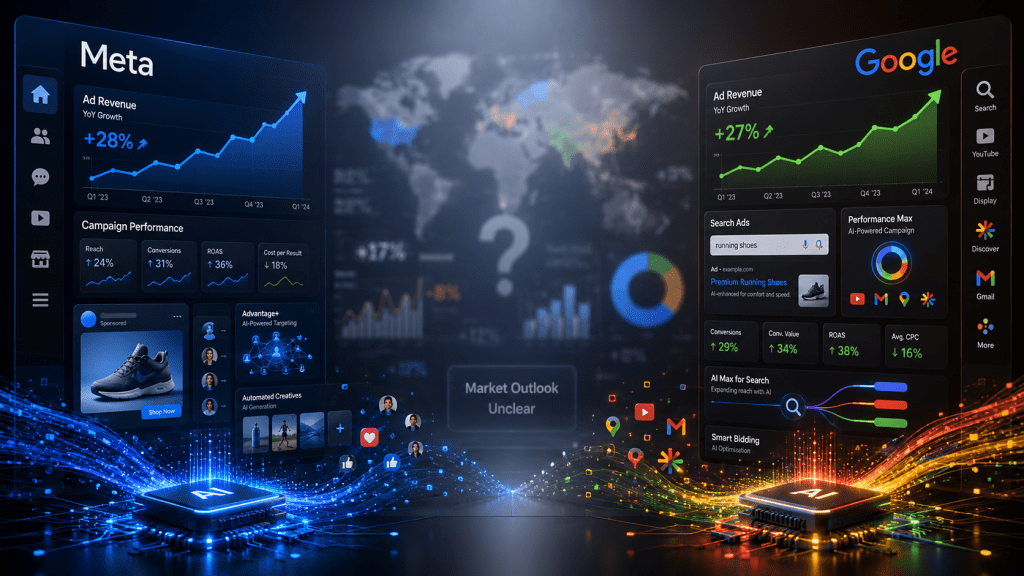
For Meta, AI has become a powerful recovery engine. After years of pressure from privacy changes, tracking limitations and competition from TikTok, Meta has rebuilt much of its advertising strength around AI-powered recommendation systems, automated campaign tools and better creative optimization.
Meta is also pushing toward deeper automation. Reuters reported that Meta aims to let brands create and target ads largely through AI by the end of 2026, allowing advertisers to provide a product image and budget while AI generates creative, targeting and campaign recommendations.
Google is following a different path. Its AI opportunity is tied to search, YouTube, Performance Max, Google Cloud and Gemini-powered products. Alphabet reported strong Q1 2026 results, with revenue growth supported by Search and Cloud, while industry analysis noted Google Search revenue growth of about 19% in Q1.
The basic logic is the same for both companies: AI makes ads easier to create, easier to target and easier to optimize.
Meta appears to be gaining momentum faster
Meta’s growth rate has recently looked stronger than Google’s. Marketing Dive reported that both companies posted impressive advertising growth in Q1, but Meta’s rate of ad revenue growth outpaced Google’s.
That matters because Meta has spent years trying to make its ad business less dependent on manual targeting and more dependent on AI-driven discovery. In that model, advertisers do not need to know exactly who to target. They provide assets, goals and budget, and Meta’s systems find the right audience across Facebook, Instagram, Reels and messaging surfaces.
This is especially attractive to small and mid-sized businesses. It lowers the technical barrier to advertising and makes campaign management feel more like setting an objective than manually building a media plan.
Emarketer has even forecast that Meta could overtake Google in global digital ad revenue in 2026, with Meta projected at $243.46 billion versus Google at $239.54 billion.
Google still has the stronger strategic foundation
Even if Meta is growing faster, Google remains structurally powerful. Search advertising is still one of the most valuable ad formats because it captures explicit intent. A user searching for a product, service or solution is often closer to purchase than someone passively scrolling a feed.
Google also benefits from a broader AI infrastructure position: Search, YouTube, Android, Chrome, Google Cloud, Gemini and advertising tools all reinforce one another. This gives Google more surfaces where AI can improve monetization.
However, Google’s challenge is more existential. AI-generated answers could reduce traditional search behavior, reduce clicks to publishers and change how users discover products. If AI answers become the interface, Google must monetize without damaging the usefulness of the experience.
That is why the picture is blurry: AI strengthens Google’s ad engine, but it also changes the rules of search.
The hidden issue: AI is expensive
AI-powered advertising is not free. Behind every smarter campaign tool is a costly infrastructure layer: data centers, chips, model training, inference costs, engineering talent and cloud capacity.
This is where investors and marketers are watching carefully. Strong ad revenue makes heavy AI investment easier to justify, but the long-term return is still uncertain. The question is not whether AI improves advertising performance. It clearly can. The question is whether the incremental revenue is enough to justify the infrastructure race.
Google is under less pressure than many AI competitors because it already has massive cash flow, cloud infrastructure and decades of advertising dominance. Meta, meanwhile, must convince the market that AI spending supports the core ad business and is not only funding speculative bets.
What this means for advertisers
For brands and agencies, the message is practical: AI-driven advertising is becoming unavoidable.
Campaign success will increasingly depend on the quality of inputs given to AI systems: product feeds, landing pages, creative assets, conversion data, CRM signals, audience exclusions and measurement setup. The platforms are becoming more automated, but that does not mean strategy disappears.
Advertisers will need to focus less on manual campaign mechanics and more on:
clear positioning, better creative testing, clean conversion tracking, strong first-party data, high-quality landing pages and realistic attribution.
AI can optimize campaigns, but it cannot fix a weak offer, poor brand positioning or broken customer journey.
Key takeaway
Meta and Google are showing that AI can unlock another growth cycle for digital advertising. Meta is using AI to automate discovery and creative performance. Google is using AI to defend and extend search, YouTube and performance advertising.
But the big picture remains blurry because AI is both an accelerator and a disruptor. It improves ad platforms today while potentially changing how people search, discover, compare and buy tomorrow.
For marketers, the safest conclusion is this: AI-powered advertising is no longer experimental. But the winners will not simply be the brands that spend more on Meta or Google. They will be the brands that build better data, better creative systems and better conversion journeys around the new AI-driven ad stack.