

Artificial intelligence is no longer just a back-office productivity tool for consumer goods companies. It is becoming a core engine of product innovation.
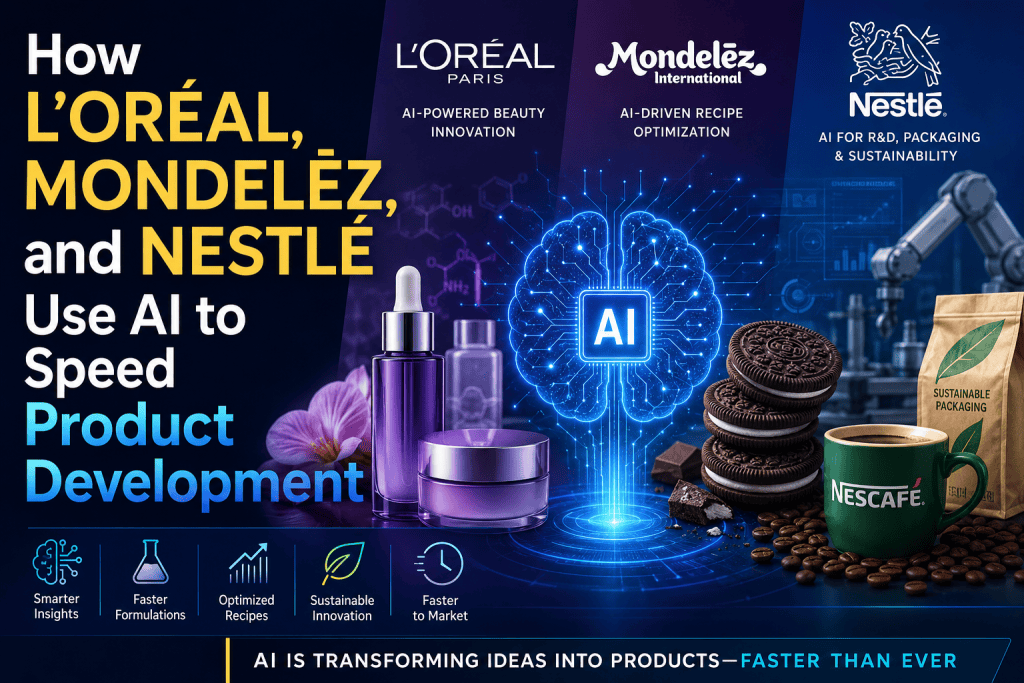
Across beauty, food, snacks, beverages and packaging, leading global brands are using AI to move faster from idea to market. L’Oréal is applying AI to beauty formulation and molecule discovery. Mondelēz is using AI to optimize recipes for brands such as Oreo, Chips Ahoy, Cadbury and Toblerone. Nestlé is leveraging AI, machine learning, data science, digital twins and advanced algorithms across R&D, recipe optimization, sustainable packaging and ingredient innovation.
This marks a major shift in how consumer products are created.
Traditionally, product development in consumer goods has been slow, expensive and heavily dependent on repeated rounds of manual testing. Teams had to identify trends, generate concepts, test ingredients, develop formulas, create prototypes, run sensory panels, assess cost, check supply chain feasibility, validate nutrition and sustainability goals, and prepare production at scale.
AI does not remove the need for scientists, formulators, chefs, product developers, marketers or consumer insight teams. But it changes the speed and precision of their work. Instead of testing every possible option manually, teams can use AI to narrow the field, identify promising combinations, simulate outcomes, optimize trade-offs and focus human expertise where it adds the most value.
For companies like L’Oréal, Mondelēz and Nestlé, AI is becoming a competitive advantage in one of the most important areas of business: creating products that consumers actually want, faster than competitors can.
Why AI Is Transforming Product Development
Consumer product development is becoming more complex.
Brands must respond to rapidly changing consumer preferences, fragmented markets, health expectations, sustainability requirements, supply chain volatility, ingredient constraints, personalization demands and intense competition. A new shampoo, snack, drink, packaging material or nutritional product must satisfy many requirements at once.
It must be desirable.
It must taste, feel or perform well.
It must be affordable.
It must be manufacturable.
It must meet safety and regulatory requirements.
It must fit the brand.
It must align with sustainability goals.
It must be launched quickly enough to capture market demand.
This is difficult because product development is full of trade-offs.
For example, in food and snacks, improving nutrition can affect taste or texture. Reducing cost can change ingredient quality. Making packaging more sustainable can affect shelf life. Changing a formula can impact manufacturing stability. Reformulating a beauty product can alter texture, sensoriality, performance or safety.
AI is valuable because it can analyze huge amounts of data and identify patterns that would be difficult or impossible for humans to process manually. It can support decisions across several dimensions at once: ingredient performance, consumer trends, cost, nutrition, sustainability, sensory attributes, formulation stability and production feasibility.
The result is not just faster product development. It is more informed product development.
The New AI-Powered Product Development Model
AI is changing the product development lifecycle in several key stages.
1. Trend Detection
Before a company develops a product, it needs to understand what consumers will want next. Traditional trend research often relies on surveys, market reports, social listening and expert analysis. These remain useful, but AI can process larger and more dynamic data sources.
AI tools can scan social media, search behavior, product reviews, influencer content, ingredient conversations, regional trends and emerging lifestyle signals. This helps brands identify weak signals earlier.
For example, L’Oréal has developed AI-powered trend detection capabilities to identify emerging beauty trends across skincare, haircare and makeup. Instead of simply reacting to trends once they are visible in the market, the company aims to anticipate consumer expectations before they become mainstream.
This matters because speed in product development starts before the lab. The faster a company can detect a meaningful trend, the faster it can develop products around it.
2. Concept Generation
Once a trend is identified, AI can help generate product concepts.
A food company might ask AI to suggest snack ideas based on consumer interest in protein, indulgence, lower sugar, plant-based ingredients or regional flavors. A beauty company might use AI to explore new combinations of ingredients, textures and benefits. A packaging team might use AI to identify new material structures that meet functional and sustainability needs.
AI can generate a broader range of possibilities than a human team could manually produce in the same time. This expands the creative search space.
However, good product development is not about generating random ideas. It is about generating commercially relevant, technically feasible and brand-compatible ideas. That is why human experts remain essential. AI can propose options, but product teams must judge whether those options make sense for the consumer, the brand and the business.
3. Formulation and Recipe Optimization
This is where AI becomes especially powerful.
Consumer products often depend on complex formulas or recipes. A shampoo, chocolate bar, biscuit, coffee pod, skincare cream or pet nutrition product may include many ingredients that interact with each other. Changing one ingredient can affect texture, taste, cost, shelf life, nutrition, stability, sustainability or manufacturing behavior.
AI can help model these interactions.
Instead of creating hundreds of physical prototypes, product developers can use AI to predict which combinations are most likely to work. This reduces the number of lab iterations and helps teams focus on the most promising options.
Mondelēz, for example, has used AI to support recipe development and optimization. Its AI tools can help evaluate formulas across multiple dimensions such as taste, texture, ingredient cost, nutrition and sustainability. This allows food scientists to explore new recipes or improve existing ones faster than traditional trial-and-error methods.
Nestlé also uses algorithmic recipe optimization to help product developers manage trade-offs between ingredients, nutrition, cost and sustainability while still meeting consumer expectations.
In beauty, L’Oréal is using AI to support formulation science, including work with IBM on a Formulation Foundation Model designed to help researchers manage formula complexity, test digitally before entering the laboratory and accelerate innovation.
4. Prototype Reduction
One of the biggest advantages of AI is reducing the number of physical samples needed.
In traditional product development, teams may create many prototypes before finding a viable formula. Each prototype consumes time, ingredients, lab capacity, sensory testing resources and operational budget.
AI can reduce this burden by ranking the most promising options before physical testing begins.
This does not eliminate real-world testing. A cookie still needs to be tasted. A shampoo still needs to be evaluated for performance, safety and consumer experience. A packaging material still needs to be tested for durability, barrier properties and manufacturing compatibility.
But AI can help companies avoid wasting time on weak candidates.
The value is not that AI replaces the lab. The value is that AI helps the lab work smarter.
5. Sensory and Consumer Testing
In consumer goods, technical performance is not enough. Products must feel right, taste right, smell right, look right and match consumer expectations.
AI can support sensory testing by analyzing consumer feedback, product attributes, test results and preference patterns. It can help identify which characteristics drive acceptance or rejection.
For Mondelēz, sensory science remains central. Human tasters and food scientists still validate whether a product works. AI helps accelerate the process, but final judgment still depends on human expertise and consumer response.
This human-AI combination is likely to become the dominant model: AI handles complexity and speed, while humans handle judgment, taste, creativity, ethics and brand meaning.
6. Supply Chain Adaptation
AI can also help product teams respond to supply chain volatility.
Consumer goods companies often depend on specific ingredients, suppliers, materials and manufacturing constraints. If an ingredient becomes expensive, scarce or problematic from a sustainability perspective, reformulation may be required.
AI can help identify alternative ingredients or formulations that maintain product quality while reducing dependency on single-source supply chains. This is especially important in food, beauty and packaging, where ingredient availability and cost can fluctuate significantly.
For global companies, this can be a strategic advantage. Faster reformulation means faster resilience.
7. Sustainability Optimization
Sustainability has become a central requirement in product development.
Companies are under pressure to reduce emissions, improve packaging, optimize ingredients, lower waste, reduce virgin plastic, improve recyclability and create products that align with environmental targets.
AI can support sustainability by helping product teams evaluate multiple trade-offs at once. For example:
- Can the product use a more sustainable ingredient without reducing performance?
- Can packaging be lighter while still protecting the product?
- Can a recipe reduce environmental impact while maintaining taste?
- Can manufacturing simulations reduce waste?
- Can alternative materials improve recyclability?
Nestlé’s AI and deep tech work on packaging innovation is a good example. The company has collaborated with IBM to develop generative AI tools that can identify novel high-barrier packaging materials, which could support the development of more sustainable packaging solutions.
8. Faster Commercialization
The final benefit is speed to market.
AI can compress timelines across discovery, formulation, testing, optimization and launch preparation. In highly competitive categories, this speed matters.
Beauty, snacks, food and beverages are trend-driven markets. If a company takes too long to respond to emerging consumer demand, a competitor may capture the opportunity first.
AI gives companies the ability to act faster while maintaining scientific and consumer validation.
L’Oréal: AI as a Beauty Innovation Engine
L’Oréal is one of the most advanced examples of AI-driven product innovation in the beauty industry.
The group has invested heavily in beauty tech, combining scientific research, data, digital tools, consumer intelligence and artificial intelligence. Its AI strategy is not limited to marketing or personalization. It extends into the core of beauty product development.
AI for Trend Detection
L’Oréal uses AI to detect and predict beauty trends across categories such as skincare, haircare and makeup. This allows the company to identify emerging consumer needs earlier and translate those signals into product opportunities.
In beauty, trend timing is critical. Ingredients, textures, routines and aesthetic preferences can rise quickly through social platforms, influencers, dermatology conversations and lifestyle shifts. AI allows L’Oréal to process these signals at scale.
This gives product teams a stronger starting point. Instead of waiting for a trend to become obvious, they can work on innovation territories before the market is saturated.
AI for Molecule Discovery and Repurposing
L’Oréal has also used AI to identify molecules from skincare that can be repurposed for haircare. This is strategically important because beauty categories often overlap at the science level. A molecule or active ingredient that delivers a benefit in one category may have potential in another.
AI can help predict how molecules may affect skin or hair, identify new associations and support faster exploration of product benefits.
This has enabled L’Oréal to move faster in formulation and innovation. Recent reporting indicates that AI has helped the company create products significantly faster than before, including innovations linked to collagen-based haircare.
AI for Formulation Science
L’Oréal’s collaboration with IBM on a Formulation Foundation Model shows where beauty R&D is heading.
Formulation is one of the most complex parts of cosmetics innovation. A product must meet many criteria at once:
- Efficacy
- Safety
- Texture
- Stability
- Sensorial experience
- Ingredient compatibility
- Consumer preference
- Sustainability
- Regulatory compliance
- Brand positioning
AI models trained on large formulation datasets can help researchers explore new combinations, anticipate performance and reduce unnecessary lab iterations.
This does not mean AI becomes the chemist. It means AI becomes a scientific co-pilot for formulation teams.
AI for Personalization and Consumer Experience
L’Oréal also uses AI in consumer-facing experiences, such as diagnostics, recommendation engines and beauty matching. These tools help consumers find the right products more easily.
This creates a valuable feedback loop. AI helps the company understand consumer profiles and expectations, while R&D teams use data-driven insight to create more relevant products.
The result is a more connected innovation model: trend detection, product development, personalization and consumer engagement all reinforce each other.
Mondelēz: AI for Faster Snack and Recipe Innovation
Mondelēz International, the company behind brands such as Oreo, Chips Ahoy, Cadbury, Toblerone and Ritz, is using AI to accelerate snack innovation and optimize recipes.
This is a major development because snack products are highly dependent on sensory quality. Consumers are emotionally attached to familiar brands. A small change in texture, sweetness, aroma, crunch or mouthfeel can affect acceptance.
That makes AI adoption in snacks especially interesting. The technology must improve speed and efficiency without damaging the sensory identity of iconic products.
AI-Assisted Recipe Development
Mondelēz uses AI tools to help generate and optimize recipes. These tools can analyze desired characteristics such as flavor, aroma, appearance, texture, cost, nutrition and sustainability.
This allows product developers to evaluate more possibilities faster.
For example, if a team wants to develop a new biscuit recipe, AI can help identify formulas that meet target characteristics while balancing practical constraints. It can suggest new combinations, reduce the number of samples required and help teams move more quickly from concept to prototype.
Improving Existing Products
AI is not only useful for creating entirely new products. It can also support renovation of existing products.
For a company like Mondelēz, this matters because many of its brands are long-established and highly recognizable. Consumers expect consistency, but companies still need to improve recipes, respond to dietary trends, manage costs and meet sustainability goals.
AI can help identify formula changes that preserve the core product experience while improving other factors.
Recent examples include AI-assisted work connected to Gluten Free Golden Oreo and refreshed Chips Ahoy recipes.
Human Expertise Still Matters
In food, AI cannot replace taste.
A model can recommend a recipe, but humans must still evaluate whether the product is enjoyable, emotionally satisfying and brand-appropriate. This is especially true for iconic snacks, where small sensory differences matter.
Mondelēz’s approach shows that the future of product development is not fully automated. It is augmented.
AI helps reduce complexity and accelerate experimentation. Human experts protect taste, brand equity and consumer trust.
Strategic Impact for Snack Brands
The strategic value for Mondelēz is clear:
- Faster recipe development
- Fewer unnecessary samples
- Better optimization of cost, nutrition and sustainability
- More agility in responding to trends
- Improved ability to renovate existing products
- Reduced dependency on slow trial-and-error development
In a competitive snacking market, speed and precision can be decisive.
Nestlé: AI Across R&D, Recipes, Packaging and Manufacturing
Nestlé is applying AI across a broad innovation ecosystem. Its approach includes recipe optimization, digital twins, virtual simulations, packaging innovation, personalized nutrition and agricultural science.
Because Nestlé operates across many categories, AI is not just a product development tool. It is a system-wide innovation capability.
AI for Recipe Optimization
Nestlé uses advanced algorithms to help product developers manage trade-offs between ingredients, nutrition, cost and sustainability.
This is particularly important in food and beverage development because a formula must satisfy multiple goals simultaneously. A product may need to be healthier, affordable, sustainable, stable, manufacturable and appealing to consumers.
AI can help teams identify better combinations faster.
This is especially relevant as consumers demand products that are not only tasty, but also aligned with health and sustainability expectations.
Digital Twins and Virtual Prototypes
Nestlé also uses virtual simulations and digital twins to optimize processes before applying changes physically.
Digital twins allow companies to simulate machines, manufacturing lines or product interactions in a virtual environment. This reduces the need for physical trial-and-error and can help teams make faster, more efficient decisions.
For product development, this is important because innovation does not stop at the formula. A product must also be manufactured reliably at scale.
AI and simulation can help connect R&D with production, reducing the gap between laboratory success and factory reality.
AI for Packaging Innovation
Packaging is one of the most complex and important areas of consumer product development.
Good packaging must protect the product, preserve quality, support shelf life, meet regulatory requirements, satisfy consumer expectations, work with manufacturing systems and increasingly meet sustainability goals.
Nestlé’s collaboration with IBM on generative AI for packaging materials shows how AI can support scientific discovery beyond recipes. The goal is to identify novel high-barrier packaging materials that can protect food and beverages while supporting more sustainable packaging development.
This is significant because packaging innovation can take years. AI can help accelerate the discovery of materials that meet demanding technical and environmental requirements.
AI for Ingredient and Agricultural Innovation
Nestlé is also exploring AI and data science in areas such as climate-resilient coffee. This expands the role of AI beyond product formulation into the upstream innovation pipeline.
For food companies, future product development will depend not only on recipes, but also on resilient ingredients, sustainable agriculture and reliable sourcing.
AI can help identify traits, support breeding decisions and improve the long-term sustainability of ingredient supply.
What These Three Companies Have in Common
L’Oréal, Mondelēz and Nestlé operate in different categories, but their AI strategies share several common patterns.
1. AI Is Used to Compress Time
All three companies are using AI to reduce the time required to move from idea to validated product direction.
This speed advantage comes from:
- Faster trend detection
- Faster formula exploration
- Faster recipe optimization
- Faster testing prioritization
- Faster material discovery
- Faster simulation
- Faster decision-making
The objective is not simply automation. It is acceleration.
2. AI Helps Manage Complexity
Product development involves many variables. AI is useful because it can analyze many dimensions at once.
For example:
- Taste
- Texture
- Cost
- Nutrition
- Sustainability
- Ingredient availability
- Formula stability
- Packaging performance
- Consumer preference
- Manufacturing feasibility
AI helps product teams navigate these trade-offs more intelligently.
3. AI Reduces Waste in the Innovation Process
By reducing unnecessary samples, failed prototypes and inefficient testing cycles, AI can lower waste in R&D.
This can save:
- Time
- Ingredients
- Lab capacity
- Energy
- Budget
- Human resources
It also supports sustainability goals by making the innovation process itself more efficient.
4. AI Works Best With Human Experts
None of these companies are replacing product teams with AI.
The strongest model is human-AI collaboration.
AI proposes, predicts, ranks and optimizes.
Humans interpret, taste, validate, regulate, position and decide.
This is especially important in consumer goods, where emotional connection, brand identity and sensory quality are essential.
5. AI Connects R&D With Marketing and Consumer Insight
Product development is no longer isolated from consumer intelligence.
AI helps companies connect market signals with scientific development. Trend data, product reviews, social conversations, consumer testing, formulation databases and sales insights can all feed a more integrated innovation process.
This creates a more responsive product pipeline.
Why This Matters for the Future of Consumer Goods
The use of AI by L’Oréal, Mondelēz and Nestlé signals a broader transformation in consumer goods.
For decades, large brands had the advantage of scale, distribution, manufacturing capacity and marketing power. But smaller challengers often moved faster, identifying niche trends and launching products quickly.
AI may help large companies regain speed.
By combining massive datasets, scientific expertise, global R&D networks and AI systems, established brands can accelerate innovation while maintaining quality and compliance standards.
This could reshape competition in several ways.
Faster Response to Trends
Brands will be able to respond more quickly to trends in beauty, food, wellness, sustainability and lifestyle.
More Personalized Products
AI will make it easier to develop products for specific consumer segments, regional preferences or individual needs.
More Efficient Reformulation
Companies will be able to reformulate products faster in response to ingredient shortages, cost pressure, regulation or sustainability targets.
Shorter Innovation Cycles
The traditional product development cycle could be compressed from years to months, or from months to weeks, depending on the category and complexity.
More Data-Driven Creativity
Creative product ideas will increasingly be supported by data, simulations and predictive models.
Stronger Sustainability Integration
AI will help companies evaluate sustainability earlier in the development process instead of treating it as a late-stage constraint.
The Limits and Risks of AI in Product Development
While AI offers major benefits, companies must also manage its limitations.
AI Can Produce Technically Plausible but Commercially Weak Ideas
A product may look good in a model but fail with consumers. Human judgment and real testing remain essential.
Data Quality Matters
AI is only as good as the data behind it. Poor data can lead to poor recommendations, biased outputs or misleading predictions.
Consumer Trust Must Be Protected
Consumers may be skeptical of “AI-created” products if communication is handled poorly. Brands must position AI as a tool that supports quality, not as a replacement for care, craft or expertise.
Regulatory and Safety Requirements Remain Critical
In beauty, food and nutrition, safety and compliance cannot be bypassed. AI can support discovery and optimization, but products still require rigorous validation.
Brand Identity Must Be Preserved
For iconic products such as Oreo, Cadbury, Nescafé or L’Oréal Paris formulas, innovation must respect brand equity. AI-driven optimization should not make products feel generic or disconnected from what consumers love.
Sustainability Claims Must Be Verified
AI can support sustainability goals, but companies must avoid overclaiming. Environmental improvements need real evidence, not just model predictions.
Strategic Lessons for Other Brands
The AI strategies of L’Oréal, Mondelēz and Nestlé offer several lessons for other companies.
Start With High-Value Bottlenecks
AI should be applied where product development is slow, expensive or complex. This may include formulation, recipe testing, consumer insight analysis, packaging discovery or supply chain substitution.
Build Cross-Functional Teams
Successful AI product development requires collaboration between:
- R&D teams
- Data scientists
- Product managers
- Consumer insight teams
- Marketing teams
- Regulatory experts
- Sustainability teams
- Manufacturing specialists
AI should not sit in a separate innovation lab disconnected from real business workflows.
Keep Humans in the Loop
Human expertise is essential for taste, creativity, brand meaning, safety and consumer empathy.
The best AI systems support experts rather than replace them.
Create Feedback Loops
AI models improve when they receive feedback from real product testing, consumer response, sales performance and manufacturing outcomes.
Companies should treat product development AI as a learning system.
Balance Speed With Responsibility
Faster product development is valuable, but speed must not compromise quality, safety, transparency or trust.
What Comes Next
The next phase of AI in consumer product development will likely include more advanced capabilities.
Generative Formulation Models
More companies will develop AI models trained on proprietary formulation or recipe data. These models will act as copilots for scientists and product developers.
AI-Driven Consumer Simulation
Brands may increasingly use AI to simulate consumer reactions before physical testing, helping teams prioritize concepts.
Automated Compliance Screening
AI could help detect whether product concepts or formulas may raise regulatory, safety or labeling issues earlier in development.
Multi-Agent R&D Workflows
Specialized AI agents may collaborate across product development tasks: one agent for trend detection, one for ingredient research, one for formulation, one for cost optimization, one for sustainability analysis and one for compliance review.
Personalized Product Pipelines
AI may help brands develop smaller, more targeted product ranges for specific consumer groups, regions or needs.
Sustainable Material Discovery
AI-driven scientific discovery will become increasingly important for packaging, ingredients and alternative materials.
Conclusion
L’Oréal, Mondelēz and Nestlé are showing that AI is becoming a central force in consumer product innovation.
For L’Oréal, AI supports beauty trend detection, molecule discovery, formulation science and personalized consumer experiences. For Mondelēz, AI helps optimize snack recipes, reduce testing cycles and accelerate innovation across iconic brands. For Nestlé, AI supports recipe optimization, digital twins, packaging discovery, agricultural science and broader R&D transformation.
The common theme is clear: AI helps companies move faster through complexity.
It allows product teams to test more possibilities, identify better options, reduce unnecessary prototypes, respond to consumer trends and balance cost, performance, nutrition and sustainability more effectively.
But the most important lesson is that AI does not replace human expertise. In beauty, food and consumer goods, human creativity, scientific judgment, sensory evaluation and brand understanding remain essential.
The future of product development will belong to companies that combine both: the speed and analytical power of AI with the intuition, expertise and responsibility of human teams.
L’Oréal, Mondelēz and Nestlé are not simply using AI to make products faster. They are redefining how modern consumer products are imagined, tested, optimized and brought to market.
FAQ
How are L’Oréal, Mondelēz and Nestlé using AI in product development?
L’Oréal uses AI for beauty trend detection, formulation science, molecule discovery and personalization. Mondelēz uses AI to optimize recipes and accelerate snack innovation. Nestlé uses AI across recipe optimization, digital twins, packaging innovation, manufacturing processes and ingredient research.
Why is AI useful for consumer product development?
AI helps companies analyze complex data, test more possibilities, optimize formulas, reduce physical prototypes, predict consumer trends, improve sustainability trade-offs and shorten development timelines.
Does AI replace human product developers?
No. AI supports product developers, scientists, chefs, formulators and marketers by helping them work faster and make better decisions. Human expertise remains essential for taste, safety, creativity, brand identity and consumer validation.
How does AI help beauty brands like L’Oréal?
AI can help beauty brands detect trends earlier, identify promising ingredients, predict formula performance, support digital-first testing and personalize product recommendations for consumers.
How does AI help food and snack companies like Mondelēz?
AI can help food companies generate and optimize recipes, reduce the number of physical samples, balance taste with nutrition and cost, and speed up the renovation or launch of products.
How does AI help Nestlé with innovation?
Nestlé uses AI and data science to support recipe optimization, digital simulations, manufacturing efficiency, packaging innovation and ingredient-related research such as climate-resilient coffee.
Can AI improve sustainability in product development?
Yes. AI can help companies evaluate sustainability earlier by comparing ingredient choices, packaging materials, cost, recyclability, manufacturing constraints and environmental impact.
What are the risks of using AI in product development?
Risks include poor data quality, weak consumer acceptance, overreliance on automated recommendations, regulatory issues, loss of brand identity and unverified sustainability claims.
Will AI make product launches faster?
Yes, in many cases. AI can reduce time spent on research, testing, formulation and optimization, helping companies move from idea to market more quickly.
What is the future of AI in consumer goods?
The future will likely include generative formulation models, AI-assisted consumer testing, multi-agent R&D workflows, automated compliance screening, sustainable material discovery and more personalized product pipelines.