

Multi-agent AI systems are becoming one of the most important architectural patterns in modern artificial intelligence. Instead of relying on a single AI assistant or one large model workflow, organizations are now building networks of specialized agents that can plan, reason, retrieve information, call tools, delegate tasks, validate outputs, and interact with business systems.
This approach is powerful. A customer support platform can use one agent to understand the user request, another to retrieve account information, another to check policies, another to generate a response, and another to escalate complex cases. A finance automation system can use different agents for invoice analysis, fraud checks, ERP updates, approval workflows, and reporting. A software engineering assistant can use one agent to inspect repositories, another to write code, another to run tests, and another to prepare documentation.
But the same structure that makes multi-agent AI powerful also makes it difficult to secure.
Every agent introduces a new identity. Every tool call creates a new authorization question. Every delegation step increases the risk of privilege escalation. Every autonomous decision can potentially trigger access to data, APIs, business workflows, or infrastructure. If permissions are not controlled precisely, a multi-agent system can silently become over-privileged, unpredictable, or difficult to audit.
This is where AWS Cedar policies become highly relevant.
Cedar is an authorization policy language developed by AWS to express fine-grained access control rules. It is also the policy language used by Amazon Verified Permissions, AWS’s managed service for centralized application authorization. By using Cedar policies, organizations can define exactly which users, agents, services, tools, and resources are allowed to interact — and under what conditions.
For multi-agent AI systems, Cedar can help answer critical security questions such as:
- Can this agent call this tool?
- Can this agent delegate a task to another agent?
- Is this agent allowed to act on behalf of this user?
- Does the original user have permission to perform the requested business action?
- Is the requested action allowed in this environment?
- Does this tool invocation require MFA, approval, or additional verification?
- Is the delegation chain still within acceptable limits?
- Does the request respect tenant isolation, data sensitivity, and compliance rules?
In short, Cedar allows organizations to move from broad, fragile, role-based access toward precise, contextual, policy-driven authorization for agentic systems.
Why Multi-Agent AI Systems Need Strong Authorization
Traditional application security often follows a relatively simple model. A user logs in, the application verifies their identity, and the system checks whether the user is allowed to perform a given action.
Multi-agent AI systems are different.
A single user request can trigger a chain of actions across multiple agents and services. For example:
- A user asks an AI assistant to prepare a quarterly financial report.
- An orchestrator agent receives the request.
- The orchestrator delegates data retrieval to a finance data agent.
- The finance data agent calls a database tool.
- Another agent summarizes the results.
- A compliance agent checks the report.
- A reporting tool generates a PDF.
- The system sends the file to the user.
This creates a much more complex authorization problem. The system does not only need to know who the user is. It must also know which agent is acting, which tool is being used, which resource is being accessed, what the original request was, and whether each step in the delegation chain is legitimate.
Without strong authorization boundaries, multi-agent systems can suffer from several security risks.
Privilege Expansion
An agent may gain access to tools or data that the original user was never allowed to access. This can happen when downstream agents are trusted too broadly or when user permissions are not carried through the full chain.
Confused Deputy Problems
A downstream service or agent may perform an action because it trusts the calling agent, even though the original user did not have the right to request that action.
Uncontrolled Tool Invocation
AI agents often interact with real tools: APIs, databases, file systems, CRMs, ERPs, payment systems, email platforms, cloud services, or ticketing systems. If tool access is not restricted, a malicious prompt, model error, or compromised agent can trigger real-world consequences.
Weak Delegation Boundaries
Agent-to-agent delegation is useful, but dangerous if unchecked. An orchestrator agent should not be able to delegate sensitive tasks to any available agent without verifying that the target agent has the right capability, trust level, and scope.
Loss of User Context
In many systems, the original user identity becomes blurred once the request moves from one agent to another. This creates auditability problems and makes it harder to prove that every action was authorized correctly.
Poor Audit Trails
If authorization decisions are hidden inside agent code or scattered across services, security teams cannot easily answer basic questions such as: who requested this action, which agent executed it, which policy allowed it, and why?
These risks make one thing clear: multi-agent AI systems need continuous, fine-grained, context-aware authorization.
Authentication alone is not enough.
What Is AWS Cedar?
Cedar is a policy language designed for application authorization. It allows developers and security teams to define access control rules separately from application logic.
Instead of hard-coding permission checks throughout the application, Cedar lets you write policies that describe who can do what, on which resource, and under which conditions.
A Cedar authorization decision is generally based on four core elements:
- Principal: the identity making the request
- Action: the operation being requested
- Resource: the object or system being accessed
- Context: request-specific information used to evaluate the decision
For example, a simple authorization question could be:
Can User Alice perform the action ReadInvoice on Invoice 123 in the current request context?
In a multi-agent system, the question may be more complex:
Can FinanceAgent invoke ERPTool on behalf of User Alice to update Invoice 123, given that Alice belongs to the correct tenant, has finance approval rights, used MFA, and the agent is operating in the production namespace with a sufficient trust score?
This is exactly the kind of authorization logic Cedar is designed to express.
Cedar and Amazon Verified Permissions
Cedar can be used as a policy language, but on AWS it is commonly associated with Amazon Verified Permissions.
Amazon Verified Permissions is a managed authorization service that uses Cedar policies. It allows teams to centralize and externalize authorization decisions for custom applications.
In practical terms:
- Cedar is the language used to write the policies.
- Amazon Verified Permissions is the AWS service that manages and evaluates those policies.
This distinction matters.
If you are building a production-grade multi-agent AI system, you usually do not want every agent, microservice, or API to implement its own authorization logic independently. That leads to inconsistent rules, duplicated code, and weak governance.
Instead, you can use a centralized authorization layer. Agents and services send authorization requests to a policy decision point, which evaluates the relevant Cedar policies and returns an allow or deny decision.
This makes authorization:
- Easier to audit
- Easier to update
- Easier to test
- Easier to govern
- More consistent across the system
- Less dependent on fragile application code
For AI systems, this separation is especially valuable because agent behavior can be dynamic. The policies remain deterministic even when the AI workflow is flexible.
Why Cedar Is a Good Fit for Multi-Agent AI Security
Cedar is particularly useful for multi-agent AI systems because it supports fine-grained, contextual authorization.
A basic role-based model might say:
“Finance users can access finance tools.”
But a multi-agent AI system needs more precise rules:
“FinanceAgent can invoke ERPTool only when acting on behalf of a finance-approved user, only for invoices belonging to the same tenant, only in production, only if the requested action matches the agent’s registered capabilities, and only if the delegation chain has not exceeded the allowed depth.”
That is a very different level of control.
Cedar allows you to model this type of rule clearly.
Key Security Principles for Multi-Agent AI Systems
Before designing Cedar policies, it is useful to define the core security principles your architecture should follow.
1. Every Agent Needs an Identity
Agents should not be anonymous components inside the system. Each agent should have a clear identity, purpose, namespace, and capability profile.
For example:
SupportTriageAgentRefundApprovalAgentCalendarAgentDataRetrievalAgentComplianceReviewAgentCodeExecutionAgent
Each identity should be linked to specific allowed actions.
2. Agents Should Not Automatically Inherit Full User Permissions
An agent acting on behalf of a user should not automatically receive every permission that user has. The agent should receive only the minimum scope required for the task.
For example, if a user asks an assistant to schedule a meeting, the scheduling agent may need calendar access, but not access to billing records, internal HR files, or production infrastructure.
3. Tool Access Must Be Explicit
Tools are where AI systems touch real business systems. A tool might send an email, update a CRM record, trigger a payment, delete a file, run code, query a database, or modify cloud infrastructure.
Every tool invocation should be explicitly authorized.
4. Delegation Must Be Bounded
Agent-to-agent delegation should have limits. The system should know:
- Which agent delegated the task
- Which agent received the task
- What scope was delegated
- How many delegation hops have occurred
- Whether the target agent is allowed to perform the requested task
5. The Original User Context Must Be Preserved
When agents act on behalf of users, downstream systems must still know who initiated the request. This is essential for compliance, audit trails, access control, and accountability.
6. Authorization Must Be Continuous
A single authorization check at the beginning of the workflow is not enough. Multi-agent systems need authorization checks at every important boundary:
- User to orchestrator
- Orchestrator to specialist agent
- Agent to agent
- Agent to tool
- Agent to resource
- Agent to external API
- Agent to high-risk action
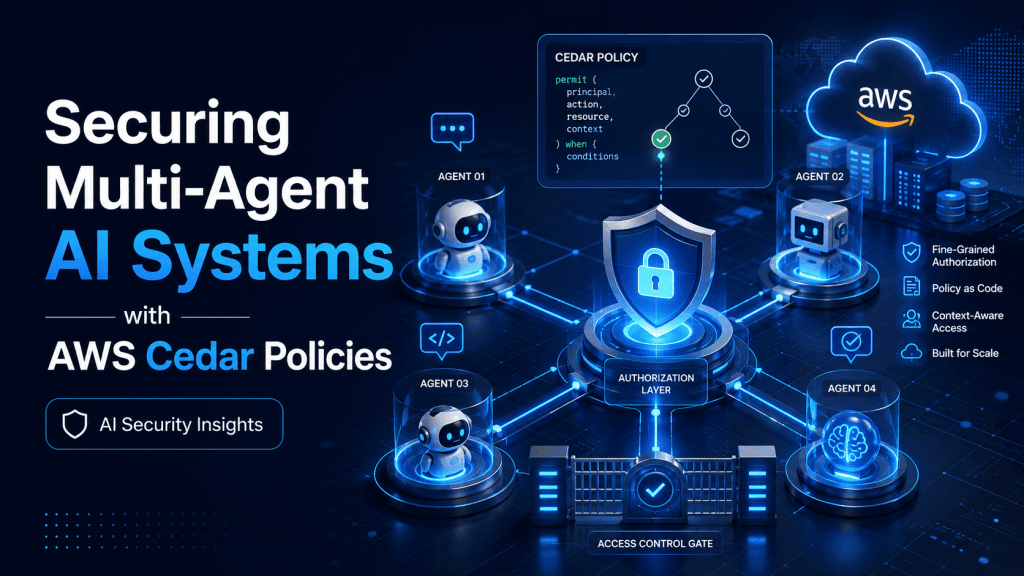
The Three-Layer Authorization Model for Multi-Agent AI
A strong way to secure multi-agent systems is to use a three-layer authorization model.
This model separates authorization into three different questions:
- Is the agent allowed to use the tool?
- Is this delegation between agents allowed?
- Is the original user allowed to perform the underlying business action?
Each layer protects against a different type of risk.
Layer 1: Agent-to-Tool Authorization
The first layer controls whether a given agent can invoke a given tool.
This matters because tools are often the point where an AI system can affect real data or real operations.
Examples of tools include:
- CRM APIs
- ERP systems
- Calendar APIs
- Email services
- Payment gateways
- File storage
- Search systems
- Database query tools
- Code execution environments
- Cloud infrastructure APIs
- Internal business workflow systems
A Cedar policy for agent-to-tool authorization may evaluate:
- Agent identity
- Tool identity
- Agent namespace
- Agent environment
- Tool sensitivity
- Agent trust level
- Registered capabilities
- Production or staging status
- Whether the tool is approved for autonomous use
Example simplified Cedar policy:
permit ( principal == App::Agent::"FinanceAgent", action == App::Action::"InvokeTool", resource == App::Tool::"InvoiceSearchTool"
)
when { principal.namespace == "finance" && principal.environment == "production" && principal.trustScore >= 4
};
This policy does not simply say that the finance agent can use every tool. It only allows a specific finance agent to invoke a specific invoice search tool when the required attributes are present.
That is the essence of least privilege.
Layer 2: Agent-to-Agent Delegation Authorization
The second layer controls whether one agent can delegate a task to another agent.
This is essential in multi-agent architectures, especially when using orchestrator or supervisor patterns.
For example:
- A
CustomerSupportAgentmay delegate refund analysis to aRefundPolicyAgent. - A
ResearchAgentmay delegate summarization to aContentAgent. - A
FinanceAgentmay delegate compliance checks to aComplianceAgent. - A
DeveloperAgentmay delegate test execution to aTestingAgent.
Delegation should not be automatic. The system should evaluate whether the delegation is allowed.
A Cedar policy may check:
- Source agent
- Target agent
- Requested task
- Delegation depth
- Capability match
- Namespace compatibility
- Tenant boundary
- Risk level
- Environment
- Whether human approval is required
Example simplified Cedar policy:
permit ( principal == App::Agent::"OrchestratorAgent", action == App::Action::"DelegateTask", resource == App::Agent::"FinanceAgent"
)
when { context.requestedCapability == "invoice_analysis" && context.delegationDepth <= 3 && resource.namespace == "finance"
};
This policy allows the orchestrator agent to delegate invoice analysis to the finance agent, but only if the requested capability matches and the delegation chain remains within an acceptable limit.
A separate explicit deny policy could prevent excessive delegation:
forbid ( principal, action == App::Action::"DelegateTask", resource
)
when { context.delegationDepth > 3
};
This kind of rule helps prevent long, opaque, uncontrolled agent chains.
Layer 3: User-to-Resource Authorization
The third layer verifies whether the original user is allowed to perform the underlying business action.
This is where many AI systems fail.
Even if the agent is valid, and even if the delegation path is valid, the system must still check whether the original user has the right to perform the action.
For example:
- Can this user access this invoice?
- Can this user approve this refund?
- Can this user view this customer record?
- Can this user export this dataset?
- Can this user update this production resource?
- Can this user trigger this workflow?
A simplified Cedar policy might look like this:
permit ( principal, action == App::Action::"ReadInvoice", resource
)
when { principal.tenantId == resource.tenantId && principal.role == "FinanceUser"
};
This policy ensures that finance users can only read invoices within their own tenant.
For more sensitive actions, you can add stronger conditions:
permit ( principal, action == App::Action::"ApproveRefund", resource
)
when { principal.role == "FinanceManager" && principal.tenantId == resource.tenantId && context.authentication.usedMFA == true && resource.amount <= principal.approvalLimit
};
This is a much stronger access model than simply allowing every finance user to approve refunds.
Modeling “Agent Acting on Behalf of User”
One of the most important authorization patterns in multi-agent AI is the “on behalf of” relationship.
In many workflows, the agent is the technical actor executing the task, but the human user is the business actor who requested it.
There are two common ways to model this.
Pattern 1: Agent as Principal, User in Context
In this model, the agent is the principal making the request. The user appears in the request context.
This is useful when the agent’s own permissions matter.
Example:
permit ( principal == App::Agent::"CalendarAgent", action == App::Action::"CreateMeeting", resource
)
when { context.onBehalfOf == App::User::"alice" && resource.owner == App::User::"alice"
};
This says the calendar agent can create a meeting on Alice’s calendar only when it is acting on behalf of Alice and the calendar resource belongs to Alice.
Pattern 2: User as Principal, Agent in Context
In this model, the user is the principal, and the agent appears in the request context.
This is useful when the user’s permissions are the primary concern, but you still want to restrict which agents can act for the user.
Example:
permit ( principal == App::User::"alice", action == App::Action::"CreateMeeting", resource
)
when { context.invokedBy == App::Agent::"CalendarAgent" && resource.owner == principal
};
This says Alice can create meetings on her own calendar when the request is executed through the approved calendar agent.
Both models can be valid. The right choice depends on whether the agent’s authority or the user’s authority should be primary in the authorization decision.
In many enterprise AI systems, you may need both.
Using Cedar Context Correctly
The context field in Cedar should be used carefully. It is designed for request-specific data, not permanent information that belongs to the principal or resource.
Good examples of context include:
- Authentication method
- MFA status
- Request time
- IP address
- Device posture
- Delegation depth
- Original user identity
- Current session risk level
- Requested capability
- Approval workflow status
- Tool invocation parameters
- On-behalf-of relationship
Information that belongs to the user, agent, or resource should usually be modeled as attributes of those entities instead.
For example:
- User role should belong to the user.
- Agent namespace should belong to the agent.
- Resource sensitivity should belong to the resource.
- Tenant ID should belong to the principal and resource.
- Tool risk level should belong to the tool.
Using context properly keeps your authorization model clean, predictable, and easier to audit.
Example Authorization Architecture on AWS
A production-ready architecture for securing multi-agent AI systems with Cedar policies may include the following components.
1. User Authentication
The user authenticates through an identity provider such as Amazon Cognito, an enterprise identity provider, or another OAuth/OIDC-compatible system.
The authentication layer confirms who the user is.
2. Agent Identity
Each agent has a distinct workload identity. This allows the system to distinguish between agents, apply policies to specific agents, and log their actions separately.
3. Agent Orchestration Layer
An orchestrator or supervisor agent receives the user request and determines which specialist agents or tools are required.
This layer should not be trusted blindly. Every delegation and tool call should still be authorized.
4. Policy Decision Point
The application sends authorization requests to a Cedar-based policy decision point, such as Amazon Verified Permissions or a custom Cedar evaluator.
The request includes:
- Principal
- Action
- Resource
- Context
- Relevant entity data
The policy decision point returns an allow or deny decision.
5. Policy Enforcement Point
The policy enforcement point is the component that actually blocks or allows the action.
This could be:
- API gateway
- Agent gateway
- Tool adapter
- MCP server
- Lambda function
- Application service
- Workflow engine
- Internal middleware
The policy enforcement point must not simply log the decision. It must enforce it.
6. Secure Tool Gateway
Tools should be exposed through controlled interfaces rather than allowing agents direct unrestricted access to APIs, credentials, databases, or cloud commands.
A gateway pattern helps centralize:
- Authentication
- Authorization
- Rate limiting
- Request validation
- Tool discovery
- Logging
- Egress controls
- Policy enforcement
7. Audit and Observability
Every important authorization decision should be logged.
A useful log entry may include:
- Request ID
- Original user
- Acting agent
- Target resource
- Requested action
- Tool invoked
- Delegation chain
- Policy decision
- Deny reason
- Timestamp
- Tenant ID
- Risk level
- Session information
This makes the system easier to investigate, govern, and improve.
Cedar Policy Examples for Multi-Agent AI
The following examples are simplified and should be adapted to your own schema, entities, and AWS architecture.
Example 1: Allow an Agent to Invoke a Specific Tool
permit ( principal == App::Agent::"SupportAgent", action == App::Action::"InvokeTool", resource == App::Tool::"CustomerLookupTool"
)
when { principal.namespace == "support" && principal.environment == "production" && resource.riskLevel == "low"
};
This policy allows the support agent to invoke a customer lookup tool only when the agent belongs to the support namespace, runs in production, and the tool is classified as low risk.
Example 2: Deny High-Risk Tool Invocation Without MFA
forbid ( principal, action == App::Action::"InvokeTool", resource
)
when { resource.riskLevel == "high"
}
unless { context.authentication.usedMFA == true
};
This policy blocks high-risk tool invocation unless MFA has been used.
Example 3: Restrict Tool Access by Environment
forbid ( principal, action == App::Action::"InvokeTool", resource
)
when { principal.environment != resource.allowedEnvironment
};
This prevents an agent running in one environment from invoking tools reserved for another environment.
Example 4: Enforce Tenant Isolation
permit ( principal, action == App::Action::"ReadCustomerRecord", resource
)
when { principal.tenantId == resource.tenantId
};
This ensures that users or agents can only access records within their own tenant.
Example 5: Limit Agent Delegation Depth
forbid ( principal, action == App::Action::"DelegateTask", resource
)
when { context.delegationDepth > 3
};
This prevents excessive agent-to-agent delegation.
Example 6: Allow Delegation Only to Agents with Matching Capabilities
permit ( principal == App::Agent::"OrchestratorAgent", action == App::Action::"DelegateTask", resource
)
when { context.requestedCapability in resource.capabilities && context.delegationDepth <= 3
};
This ensures that tasks are delegated only to agents that are registered as capable of performing them.
Example 7: Require Human Approval for Sensitive Operations
permit ( principal == App::Agent::"FinanceAgent", action == App::Action::"ApproveRefund", resource
)
when { context.humanApproval.status == "approved" && context.authentication.usedMFA == true && resource.amount <= 5000
};
This policy allows refund approval only when human approval exists, MFA was used, and the amount is within the allowed threshold.
Best Practices for Securing Multi-Agent AI with AWS Cedar Policies
1. Start with a Clear Authorization Model
Before writing policies, define your authorization model.
You should clearly identify:
- User types
- Agent types
- Tool types
- Resource types
- Business actions
- Sensitive operations
- Delegation paths
- Tenant boundaries
- Required approval levels
Do not start by writing policies randomly. Start by modeling the system.
2. Define a Strong Cedar Schema
A schema describes the structure of your authorization world. It defines which principals, actions, resources, and context values are valid.
A strong schema helps prevent inconsistent policies and malformed authorization requests.
For multi-agent systems, your schema should include:
- Agent entity types
- User entity types
- Tool entity types
- Resource entity types
- Delegation actions
- Tool invocation actions
- Business domain actions
- Context fields for delegation and authentication
3. Separate Agent Permissions from User Permissions
An agent’s permissions and a user’s permissions are not the same.
A secure system should evaluate both:
- Is the agent allowed to execute this kind of operation?
- Is the user allowed to request this business action?
This prevents agents from becoming universal proxies for user privileges.
4. Use Explicit Deny Policies for Guardrails
Cedar’s forbid policies are useful for hard security boundaries.
Use explicit deny policies for:
- High-risk tools
- Production-only actions
- Sensitive data exports
- Destructive operations
- Cross-tenant access
- Excessive delegation depth
- Missing MFA
- Missing human approval
- Untrusted agent identities
Explicit deny rules help reduce ambiguity and make security expectations clear.
5. Keep Authorization Outside the Prompt
Prompts are not security controls.
You can instruct an AI agent not to access a tool, but that should never be your only protection. The real enforcement should happen outside the model, at the policy enforcement layer.
Cedar policies are deterministic. AI model behavior is not.
Use prompts for guidance. Use Cedar for enforcement.
6. Use a Secure Tool Gateway
Agents should not have direct access to credentials, APIs, or cloud commands unless absolutely necessary.
A secure tool gateway helps control:
- Which tools are available
- Which agents can invoke them
- Which parameters are allowed
- Which actions require approval
- Which operations are logged
- Which requests are blocked
This creates a safer boundary between agent reasoning and real-world execution.
7. Preserve the Original User Identity
Whenever an agent acts on behalf of a user, preserve that relationship throughout the workflow.
Downstream services should know:
- The original user
- The acting agent
- The delegated scope
- The requested action
- The target resource
This is essential for auditability and least-privilege enforcement.
8. Limit Delegation Chains
Long delegation chains are difficult to inspect and secure.
Set hard limits on:
- Number of delegation hops
- Cross-namespace delegation
- Cross-tenant delegation
- Sensitive task delegation
- Autonomous delegation without human approval
9. Apply Strong Controls to Code Execution Agents
Agents that can run code are especially risky.
For code execution tools, consider:
- Sandboxing
- Network isolation
- File system restrictions
- Time limits
- Resource limits
- Package restrictions
- No direct access to secrets
- Mandatory authorization before execution
- Logging of commands and outputs
Cedar policies can determine whether the code execution tool may be invoked, but runtime sandboxing is still necessary.
10. Log Every Authorization Decision
For production AI systems, authorization logs are not optional.
You should log both allowed and denied decisions. Denied decisions are especially useful because they reveal attempted misuse, policy misconfigurations, or unsafe agent behavior.
11. Test Policies Before Deployment
Authorization policies should be tested like application code.
Your test suite should include:
- Expected allow cases
- Expected deny cases
- Cross-tenant access attempts
- Missing MFA scenarios
- Excessive delegation depth
- Unauthorized tool invocation
- Agent capability mismatches
- Privilege escalation attempts
- Sensitive resource access attempts
12. Review Policies Regularly
As your multi-agent system evolves, your authorization model must evolve too.
Review policies when:
- New agents are added
- New tools are introduced
- Business workflows change
- New data types are added
- Compliance requirements change
- Agent capabilities expand
- Production incidents occur
Policy drift is a real risk. Regular reviews help prevent permissions from becoming broader than intended.
Common Mistakes to Avoid
Mistake 1: Giving Agents Broad Admin Access
This is one of the most dangerous patterns. An agent should not receive broad administrative access just because it needs to perform complex tasks.
Instead, define narrow permissions for each agent and tool.
Mistake 2: Trusting the Orchestrator Too Much
The orchestrator agent should coordinate the workflow, but it should not bypass authorization. Every downstream action should still be checked.
Mistake 3: Treating Internal Agent Calls as Safe
Internal traffic is not automatically safe. Agent-to-agent communication can still create privilege escalation risks.
Mistake 4: Forgetting the Original User
If the system only checks the agent identity and forgets the user identity, it can perform actions the user was not authorized to request.
Mistake 5: Hard-Coding Permissions in Agent Logic
Hard-coded permissions are difficult to audit and update. They also create inconsistency across agents.
Centralized policy-based authorization is more scalable.
Mistake 6: Using Prompts as Security Boundaries
A prompt instruction such as “do not access sensitive data” is not a reliable security control. A policy enforcement layer must block unauthorized actions regardless of what the model says or decides.
Mistake 7: Not Logging Denied Requests
Denied requests reveal important security signals. They can show attempted abuse, unexpected agent behavior, or policy gaps.
Business Benefits of Cedar-Based Multi-Agent AI Security
Securing multi-agent AI systems with Cedar policies is not only a technical improvement. It also creates direct business value.
Better Governance
Centralized policies make it easier for security, compliance, and engineering teams to understand who can do what.
Faster AI Deployment
When access control is well structured, teams can deploy new agents and tools more confidently.
Lower Operational Risk
Fine-grained authorization reduces the chance that an agent will access the wrong data, invoke the wrong tool, or perform an unauthorized action.
Stronger Compliance
Audit logs, policy-based access, tenant isolation, and approval rules make it easier to support compliance requirements.
Improved Scalability
As the number of agents grows, centralized policy management becomes much more scalable than manual permission logic.
Reduced Blast Radius
If one agent behaves incorrectly, least-privilege policies limit the damage it can cause.
Cedar Policies vs Traditional RBAC
Traditional RBAC is useful, but often insufficient for multi-agent AI.
RBAC answers questions like:
- Is this user an admin?
- Is this user in the finance role?
- Is this user part of the support team?
Multi-agent AI systems require more detailed questions:
- Is this specific agent allowed to invoke this specific tool?
- Is the agent acting on behalf of an approved user?
- Is the requested action within the agent’s capabilities?
- Is the delegation chain still valid?
- Is the resource in the same tenant?
- Is MFA required for this operation?
- Is human approval required for this transaction?
- Is this request allowed in production?
Cedar can support RBAC, but it also supports richer attribute-based and context-aware policies. That makes it better suited for modern AI systems where authorization depends on more than just a user’s role.
Cedar Policies Are Not a Replacement for All Security Controls
Cedar policies are powerful, but they are only one part of a complete security architecture.
You should combine Cedar-based authorization with:
- Strong authentication
- Secure identity management
- MFA for sensitive actions
- Secrets management
- Network isolation
- API gateways
- Rate limiting
- Input validation
- Output validation
- Bedrock Guardrails or equivalent AI safety controls
- Logging and monitoring
- Runtime sandboxing
- Human approval workflows
- Incident response processes
Cedar answers the authorization question: should this principal be allowed to perform this action on this resource in this context?
It does not replace encryption, authentication, network security, model safety, or operational monitoring.
The strongest architectures combine all of these layers.
Implementation Roadmap
For organizations planning to secure multi-agent AI systems with AWS Cedar policies, the following roadmap can help.
Step 1: Map Your Agentic Workflow
Document every agent, tool, resource, and business action.
Identify:
- Which agents exist
- What each agent does
- Which tools each agent needs
- Which resources each tool can access
- Which actions are sensitive
- Which workflows involve delegation
Step 2: Define Identities
Create a clear identity model for:
- Human users
- AI agents
- Tools
- Services
- Tenants
- Resources
Avoid anonymous or shared agent identities.
Step 3: Classify Tools by Risk
Not all tools have the same risk level.
For example:
- Low risk: search, read-only FAQ retrieval
- Medium risk: CRM lookup, calendar availability checks
- High risk: payment actions, data export, email sending, infrastructure changes, code execution
Use this classification in Cedar policies.
Step 4: Create the Cedar Schema
Define your principal types, resource types, actions, and context fields.
This becomes the foundation of your authorization system.
Step 5: Write Least-Privilege Policies
Start narrow.
Create policies that allow only what is necessary.
Use explicit deny policies for high-risk boundaries.
Step 6: Add Policy Enforcement Points
Place enforcement at every important system boundary:
- Before tool invocation
- Before agent delegation
- Before accessing sensitive resources
- Before executing code
- Before sending external communications
- Before modifying business records
Step 7: Add Audit Logging
Log every decision with enough detail to support investigation and compliance.
Step 8: Test and Red-Team the System
Test normal workflows and malicious scenarios.
Try to break the authorization model before attackers or faulty agent behavior do.
Step 9: Monitor and Improve
Use logs and incidents to improve the policy model over time.
Example Use Cases
Customer Support Automation
A multi-agent support system may include:
- Triage agent
- Customer lookup agent
- Refund policy agent
- Escalation agent
- Email drafting agent
Cedar policies can ensure that:
- Only support agents can access customer records
- Refund actions require the correct user role
- High-value refunds require approval
- Email tools cannot send messages without validation
- Agents cannot access customers from another tenant
Finance Operations
A finance AI workflow may include:
- Invoice analysis agent
- ERP tool
- Fraud detection agent
- Approval workflow agent
- Reporting agent
Cedar policies can ensure that:
- Agents can only access finance tools
- Users can only view invoices from their tenant
- Refund approvals require MFA
- Large transactions require human approval
- Reports cannot include unauthorized data
Software Engineering Agents
An AI software development system may include:
- Repository analysis agent
- Code generation agent
- Test execution agent
- Documentation agent
- Deployment assistant
Cedar policies can ensure that:
- Code execution happens only in sandboxed environments
- Production deployment requires approval
- Agents cannot access secrets directly
- Repository access is scoped by project
- Destructive operations are blocked by default
Data Analytics Agents
A data analysis workflow may include:
- Query planning agent
- Data retrieval agent
- Visualization agent
- Compliance filter agent
- Report generation agent
Cedar policies can ensure that:
- Sensitive datasets require specific authorization
- Personal data cannot be exported without approval
- Users can access only permitted data domains
- Agents cannot bypass compliance review
- Generated reports respect tenant and role restrictions
Conclusion
Multi-agent AI systems are powerful because they distribute work across specialized agents. But that same distribution creates a serious authorization challenge.
In a multi-agent system, security cannot stop at user login. Every agent, every tool, every resource, and every delegation step must be governed by clear authorization rules.
AWS Cedar policies provide a strong foundation for this model. They allow teams to express fine-grained, context-aware access control rules that are separate from application code and easier to audit. When combined with Amazon Verified Permissions, Cedar can become the central authorization layer for production-grade AI systems.
The most secure approach is to enforce authorization across three layers:
- Agent-to-tool access
- Agent-to-agent delegation
- Original user-to-resource authorization
This model helps prevent privilege escalation, uncontrolled tool usage, confused deputy risks, and loss of user context.
As organizations move from AI prototypes to real agentic platforms, authorization will become one of the most important design decisions. Cedar gives developers, architects, and security teams a practical way to keep multi-agent AI systems secure, scalable, and governable.
The future of AI automation will not only depend on smarter agents. It will depend on safer agents — agents that operate within clear, enforceable, auditable boundaries.
Cedar policies are one of the most effective ways to build those boundaries on AWS.
FAQ
What is AWS Cedar?
Cedar is an authorization policy language developed by AWS. It is used to define fine-grained access control rules for applications and is the policy language used by Amazon Verified Permissions.
What is Amazon Verified Permissions?
Amazon Verified Permissions is a managed AWS authorization service that uses Cedar policies. It helps developers centralize and externalize authorization decisions from application code.
Why is Cedar useful for multi-agent AI systems?
Cedar is useful because multi-agent AI systems require fine-grained authorization across users, agents, tools, resources, and delegation chains. Cedar makes it possible to define these rules clearly and consistently.
Can Cedar control agent-to-agent delegation?
Yes. Cedar policies can be designed to control whether one agent is allowed to delegate a task to another agent based on capability, namespace, trust level, delegation depth, tenant boundary, or other contextual attributes.
Can Cedar control which tools an AI agent can use?
Yes. Cedar can be used to define which agents can invoke which tools and under what conditions. This is especially important for tools that access sensitive data, execute code, send messages, update business systems, or modify cloud resources.
Is Cedar a replacement for IAM?
No. Cedar is focused on application-level authorization. AWS IAM controls access to AWS resources and services. In many architectures, IAM and Cedar complement each other.
Should AI agent permissions be controlled only through prompts?
No. Prompts are not reliable security boundaries. They can guide agent behavior, but authorization should be enforced outside the model through deterministic controls such as Cedar policies.
What is the best authorization model for multi-agent AI?
A strong model is to enforce authorization at three levels: agent-to-tool access, agent-to-agent delegation, and original user-to-resource access. This ensures that both the agent’s authority and the user’s authority are checked.
How does Cedar help with compliance?
Cedar helps compliance by making authorization rules explicit, centralized, testable, and auditable. Combined with logging, it can help organizations demonstrate who had access to what and why a specific action was allowed or denied.
What should be logged in a multi-agent AI authorization system?
You should log the original user, acting agent, action, resource, tool, delegation chain, context, policy decision, timestamp, tenant ID, and deny reason when applicable.