



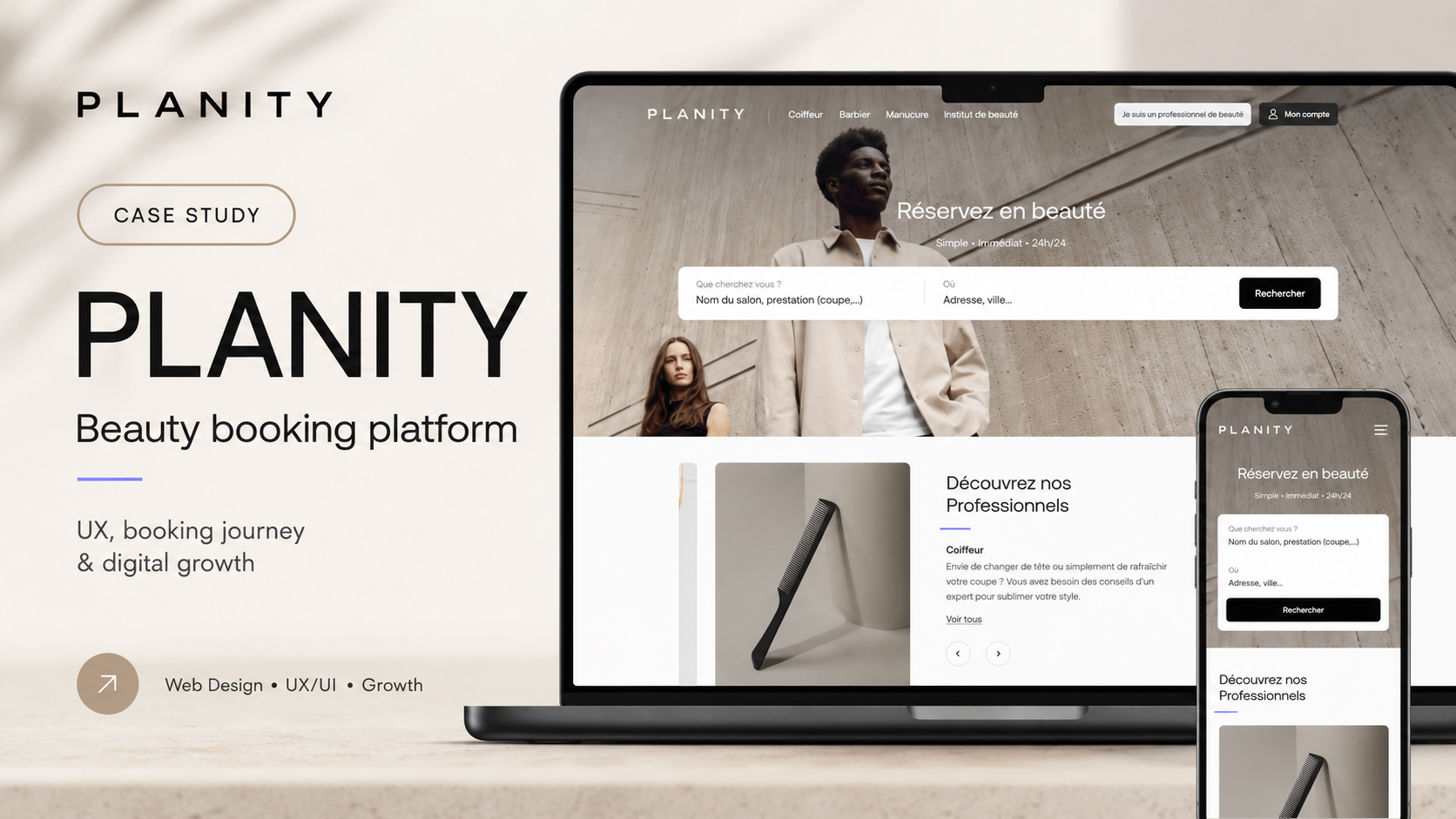
Planity – Beauty Booking Platform
Building a leading digital booking platform for the beauty and wellness industry
Planity is an online appointment-booking platform dedicated to beauty and wellness services. The website connects consumers with hairdressers, barbers, nail salons, beauty institutes, spas, massage therapists and wellness practitioners, while also offering professionals a digital solution to manage bookings more efficiently.
Our objective was to create a platform that serves two audiences at the same time: customers who want to book quickly, and professionals who need a reliable tool to fill their schedule, reduce no-shows and grow their activity.

The Challenge
The beauty and wellness sector is highly fragmented. Customers often search by service, location, availability, reputation and convenience, while professionals need visibility, organisation and a booking system that works even outside opening hours.
The challenge was to simplify this ecosystem into one clear digital journey. The website needed to make appointment booking feel instant and effortless for users, while also making Planity credible and attractive for salons, institutes and independent professionals.
The platform also had to support a large number of categories and locations without becoming visually heavy or difficult to navigate.
Our Solution
We built the website around a simple and powerful promise: booking beauty services should be easy, immediate and available 24/7.
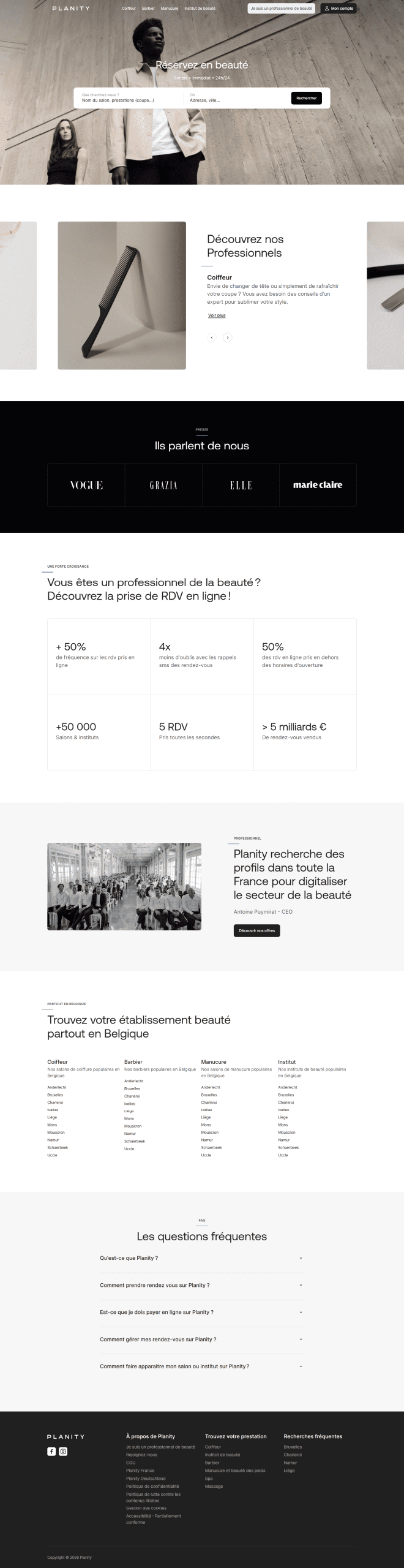
The homepage focuses immediately on search intent. Users are invited to choose what they are looking for and where, then move directly into booking. This keeps the experience practical and conversion-oriented from the first screen.
The platform architecture was structured around major service categories such as hairdressers, barbers, manicure, beauty institutes, spa, reflexologists, massage therapists, sophrologists, hypnotherapists, naturopaths and life coaches. This broad categorisation allows Planity to position itself not only as a hair and beauty booking tool, but as a wider wellness marketplace.
UX and Conversion Strategy
The user experience was designed around speed and clarity. The search interface reduces friction by asking two essential questions: what service the user wants and where they want to book it.
For consumers, the platform removes common pain points: waiting on the phone, calling during opening hours, searching manually for trusted providers, and forgetting appointment details. Planity explains that users can book in a few clicks, receive SMS reminders, and modify or cancel appointments through the same digital journey.
For professionals, the website turns the platform into a business growth tool. It highlights online appointment frequency, fewer missed appointments through SMS reminders, bookings made outside opening hours, and the scale of the salon and institute network. These proof points give the B2B offer commercial weight and make the platform feel like an operational solution, not just a directory.
Brand Positioning
Planity’s positioning is built around convenience, accessibility and digital transformation for the beauty sector.
For consumers, the brand promise is simple: find the right beauty or wellness professional and book instantly.
For professionals, the message is more strategic: Planity helps digitalise the business, improve schedule occupancy, reduce missed appointments and capture demand even when the salon is closed.
The website succeeds because it balances both sides of the marketplace. It is not only a consumer booking tool and not only a professional SaaS product. It connects both audiences through one shared value proposition: easier appointment management.
Content and SEO Strategy
A major strength of the website is its category and location content. Planity creates dedicated entry points for popular beauty categories and cities across France, including hairdressers, barbers, manicure salons, beauty institutes, massages and wellness practitioners in major cities such as Paris, Lyon, Marseille, Bordeaux, Lille, Nice, Nantes, Strasbourg, Toulouse and Montpellier.
This structure supports organic visibility while helping users land directly on pages that match their intent. Instead of relying only on a generic homepage, the website creates a scalable SEO architecture around service type and location.
The FAQ also strengthens the platform’s educational role by explaining what Planity is, how to book, how confirmations work, and how the service benefits both users and professionals.
Key Results
The final platform creates a clear, scalable and conversion-focused digital experience for the beauty and wellness market.
For consumers, it simplifies discovery and booking.
For professionals, it reinforces the value of online scheduling, SMS reminders, extended booking availability and increased appointment frequency.
For the brand, it strengthens Planity’s position as a leading booking platform for beauty and wellness services, supported by strong social proof and high-volume marketplace indicators.
Conclusion
Planity’s website demonstrates how a digital platform can transform a traditional appointment-based sector into a faster, more accessible and more efficient experience.
By combining a direct search journey, clear category architecture, strong B2B proof points, local SEO content and practical reassurance, the platform successfully serves both sides of the beauty marketplace.
The result is a website designed not only to generate bookings, but to change the way customers and professionals organise beauty and wellness appointments.
Key points of the project
- Marketplace UX design
- Booking journey optimization
- Search experience design
- Category page structure
- Local SEO architecture
- B2B conversion strategy
- Trust signal integration
- Professional onboarding flow
- FAQ content strategy
- Mobile-first interface
