



Résidence L’Aristide – Website
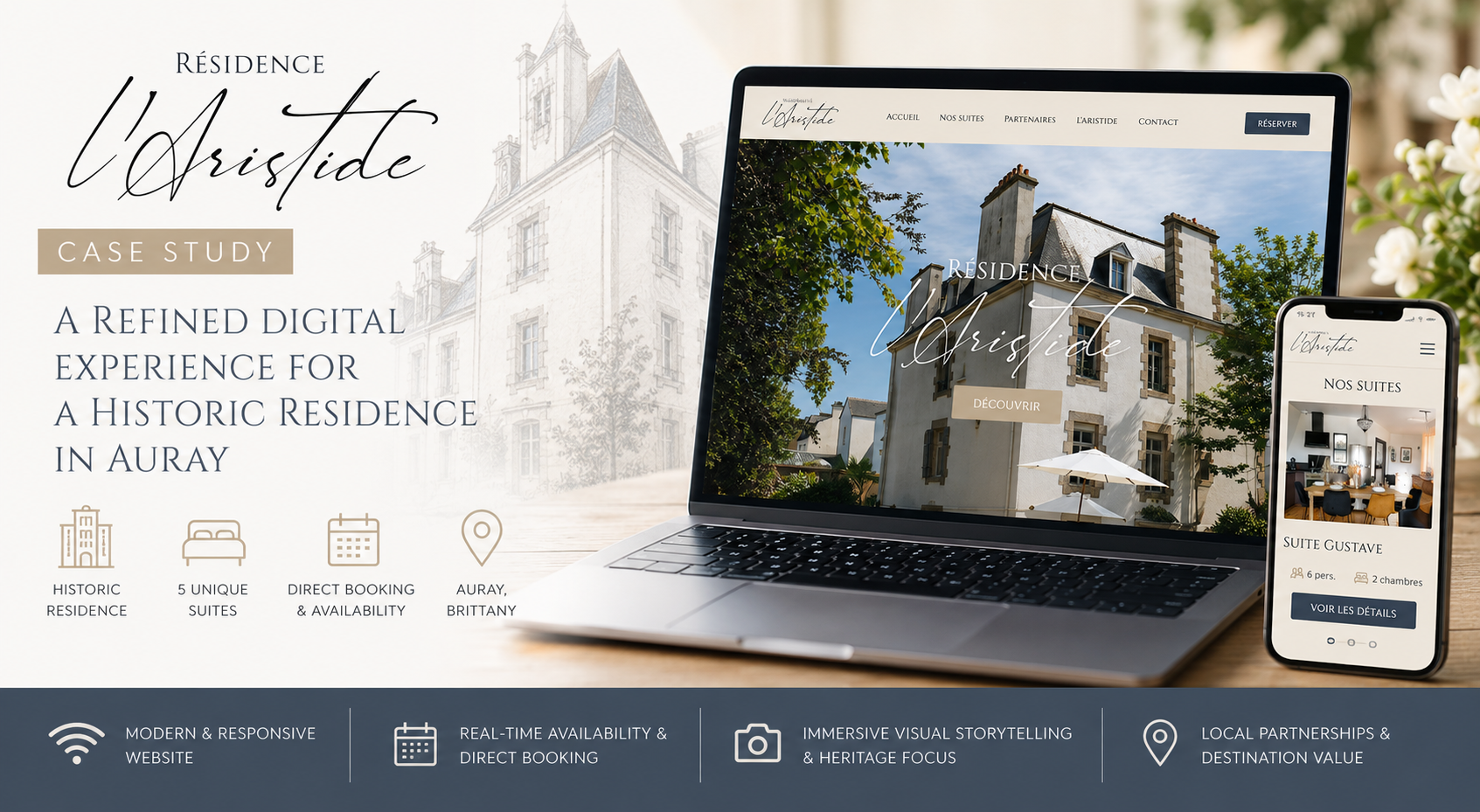
For Résidence L’Aristide, the objective was to create a refined hospitality website capable of presenting the character of a historic residence, differentiating five individually designed suites, and turning visitor interest into direct accommodation enquiries and bookings.
Located in Auray, Brittany, L’Aristide is a restored early-19th-century neoclassical villa that had remained unoccupied for more than 30 years before being renovated by its new owners. The property now offers five furnished apartments for professional stays, weekends and holidays, with capacities of up to six guests.

Project Challenge
The central challenge was to communicate two different dimensions of the property without allowing either to dominate the experience.
On one side, L’Aristide is a functional accommodation offer. Guests need to understand capacity, equipment, sleeping arrangements, availability and booking conditions quickly.
On the other, the residence is a heritage property with a personal renovation story, distinctive architecture and individually styled interiors. Reducing the website to a conventional accommodation catalogue would have weakened the emotional value of the property. Focusing only on storytelling, however, would have made the booking journey less efficient.
The website therefore needed to combine:
- heritage-led brand storytelling;
- clear suite comparison;
- practical stay information;
- availability and reservation functions;
- local destination credibility;
- direct contact and reassurance.
Brand Positioning
The digital positioning was built around the idea of a character residence rather than standardized tourist accommodation.
The history of the villa provides the foundation for that positioning. The owners present the project as the restoration of a remarkable local building and connect it to their attachment to Auray, its heritage and its architecture. This owner-led narrative gives the brand a more personal and authentic dimension than a conventional serviced-apartment platform.
Each suite also has its own decorative identity:
- Aretha, inspired by the 1950s;
- Louison, with a Haussmann-style atmosphere;
- Malo, influenced by the seaside;
- Naomi, with a more exotic direction;
- Gustave, referencing the late 19th century and the era in which the property was built.
This naming system turns the accommodation range into a collection of distinct experiences. From a branding perspective, it creates stronger memorability and gives each unit a narrative role rather than presenting it merely by apartment number.
Information Architecture
The website architecture was kept deliberately focused around the main stages of the customer journey:
Home, for the overall positioning and introduction to the property.
Our Suites, for accommodation discovery and booking.
Partners, for the local ecosystem.
L’Aristide, for the history and owners’ story.
Contact, for direct enquiries.
A persistent Book call to action reinforces the primary conversion objective across the navigation.
This relatively compact architecture is appropriate for a five-suite residence. Rather than spreading content across many thin pages, the structure concentrates attention on the property, the accommodation and the booking decision.
Suite Discovery and Product Structure
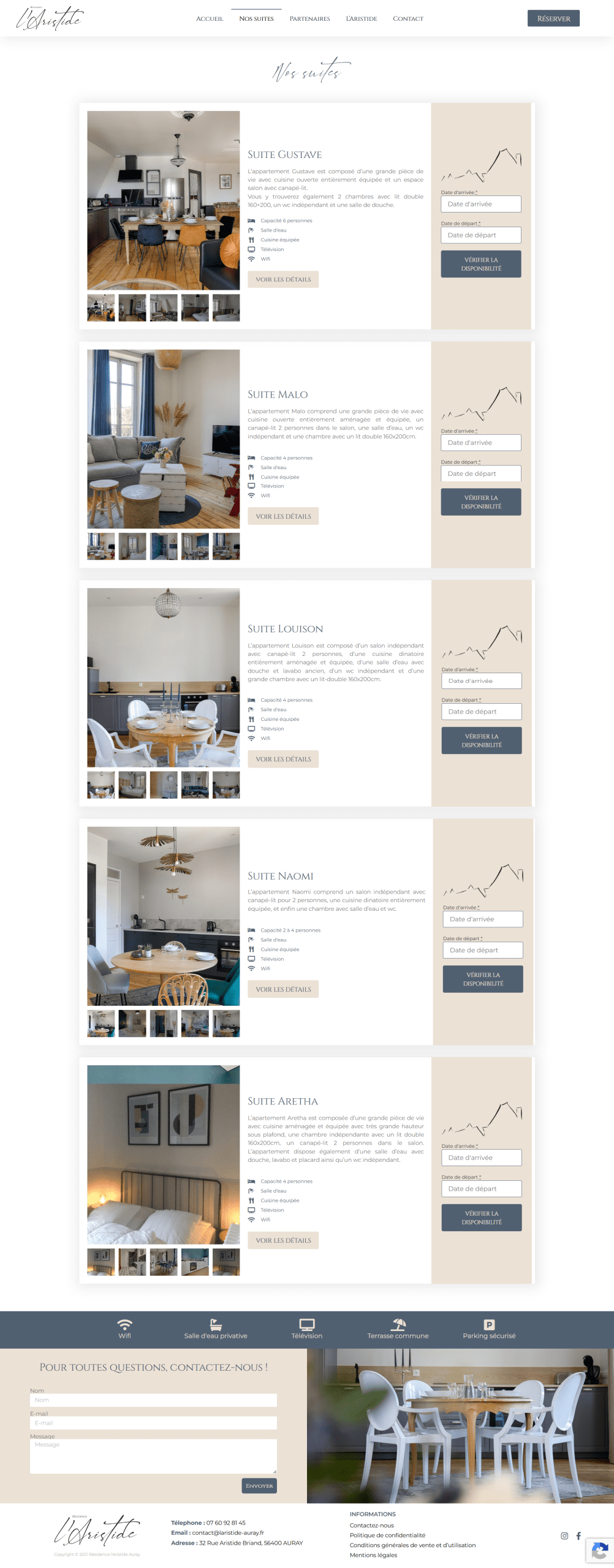
The suites page functions as the main commercial layer of the website. Each accommodation is presented with:
- a dedicated name and visual identity;
- an interior description;
- maximum guest capacity;
- sleeping configuration;
- kitchen and bathroom information;
- essential amenities;
- access to further details;
- arrival and departure date selection;
- availability feedback.
The five suites cover several stay profiles. Gustave accommodates up to six guests, while Malo, Louison and Aretha accommodate four. Naomi is positioned for two to four guests. All include an equipped kitchen, private washing facilities, television and Wi-Fi.
This structure helps users compare accommodation according to practical criteria without disconnecting those criteria from the residence’s more emotional positioning.
Booking and Conversion Strategy
The booking flow is embedded directly within the suite discovery environment. Visitors can enter arrival and departure dates and receive availability information for the selected accommodation.
This reduces the distance between inspiration and action. Instead of requiring users to leave the property presentation and navigate to an unrelated booking interface, availability is introduced where purchase intent is strongest.
The conversion system is supported by several secondary actions:
- repeated booking buttons;
- “View details” links for deeper evaluation;
- a site-wide contact form;
- visible telephone and email details;
- social media access.
The result is a dual conversion model: guests can proceed through the reservation route or contact the residence directly when their stay requires clarification.
Content and Visual Storytelling
The website relies heavily on the property itself as the main source of visual differentiation. The gallery presents architectural and lifestyle elements including the historic staircase, furnished apartments, terrace, materials, workspaces, bedrooms and decorative details.
This visual strategy supports several messages simultaneously:
- restoration quality;
- atmosphere and comfort;
- architectural authenticity;
- variety between suites;
- suitability for leisure and professional stays.
The owners’ story adds context to those images. Rather than showing a renovated building without explanation, the website links the result to a personal investment in local heritage.
Local Partnership Strategy
The partners section connects L’Aristide with a broader local network including craftspeople, a soap maker, a restaurant, transport services, a concierge and a photographer.
From a marketing perspective, this contributes to the platform in three ways.
First, it reinforces the residence’s local anchoring. Second, it creates a more complete guest ecosystem beyond accommodation alone. Third, it introduces opportunities for reciprocal visibility and referral traffic between complementary businesses.
This is particularly relevant for an independent hospitality property, where perceived local expertise can be an important competitive advantage over standardized booking-platform listings.
User Experience
The user experience is based on a straightforward hospitality funnel:
Discover the residence → understand its identity → compare suites → check availability → reserve or contact.
The repeated presentation of key amenities—Wi-Fi, private bathroom, television, shared terrace and secure parking—provides reassurance without requiring visitors to inspect every suite individually.
The website also supports different audience segments:
- couples seeking a distinctive weekend stay;
- families or groups requiring several sleeping spaces;
- professionals needing furnished accommodation;
- travellers looking for a longer holiday base in Auray.
Technical and Functional Considerations
The platform combines editorial hospitality content with transactional components:
- structured suite listings;
- image galleries;
- date-based availability fields;
- booking calls to action;
- enquiry forms;
- legal and privacy documentation;
- cookie-consent management;
- responsive navigation;
- social-media integration.
This modular setup allows the property to present itself independently while retaining the essential functions expected from a modern accommodation website.
The site also centralizes the residence’s address, telephone number and email, which supports both user reassurance and local search consistency. The listed address is 32 Rue Aristide Briand, 56400 Auray.
Marketing Value
The website acts as more than an online brochure. It provides L’Aristide with a direct digital channel that can reduce dependence on third-party accommodation platforms.
Its principal marketing functions are:
- establishing a distinctive brand around the restored villa;
- presenting all five suites in a coherent product portfolio;
- supporting direct reservation intent;
- improving visibility for accommodation searches around Auray;
- communicating the owners’ story and local credibility;
- building partnerships within the regional tourism ecosystem;
- providing complete information before a guest makes contact.
The combination of heritage content and practical booking functionality helps preserve the property’s premium, independent identity while supporting commercial performance.
Outcome
The resulting website gives Résidence L’Aristide a coherent digital presence aligned with the property itself: elegant, personal and rooted in local heritage.
It transforms a complex offer—a historic villa, five differently styled apartments, several capacities and multiple types of stay—into a clear customer journey. Visitors can understand the story, explore each suite, evaluate amenities, check dates and proceed toward a direct booking or enquiry.
The platform therefore serves as both a hospitality showcase and a direct-acquisition tool, helping L’Aristide convert the architectural and emotional value of the residence into qualified stay requests.
Key points of the project
- Heritage-led hospitality positioning
- Five-suite accommodation architecture
- Integrated availability journey
- Direct-booking conversion path
- Detailed suite comparison
- Owner and renovation storytelling
- Visual property gallery
- Mobile-friendly navigation
- Local SEO foundations
- GDPR and cookie-consent framework
- Social-media integration
