



Sabi Sabi – Hospitality & Luxury Safari Website
Designing a Luxury Safari Platform That Sells an Experience, Not Just a Stay
Sabi Sabi is a family-owned South African private game reserve in the Greater Kruger area, operating since 1979. Its offer combines four distinct luxury lodges, immersive wildlife encounters, refined hospitality, conservation, community engagement, wellness, dining, and special-interest experiences. The website therefore needed to function as far more than a hotel booking platform: it had to translate the emotional, sensory, and aspirational value of a high-end African safari into a coherent digital journey.
The central challenge was to balance inspiration with utility. Visitors need to dream about the destination, but they also need to compare lodges, understand activities, review rates and packages, access travel information, and submit a detailed booking enquiry. The resulting website combines cinematic storytelling with a deep, conversion-oriented information architecture.

Project Context
Sabi Sabi offers four luxury safari lodges, each built around a distinct character:
- Selati Camp, inspired by the glamour of the late-19th-century safari era
- Bush Lodge, positioned as a vibrant and welcoming luxury home in the bush
- Little Bush Camp, a more secluded and intimate riverside retreat
- Earth Lodge, a contemporary, design-led interpretation of safari luxury
Together, these properties express the brand’s broader “yesterday, today and tomorrow” philosophy. The website needed to make each lodge feel individually desirable while still presenting them as part of one cohesive Sabi Sabi experience.
At the same time, the platform had to support multiple audiences: couples, families, honeymooners, groups, wildlife enthusiasts, photographers, birders, international travel planners, and trade partners.
The Challenge
1. Selling an intangible experience
Luxury safari travel is purchased largely through emotion, imagination, and trust. A standard room-and-rate presentation would not be sufficient. The website had to communicate the thrill of close wildlife encounters, the intimacy of the bush, the quality of the hospitality, and the transformative nature of the destination before a guest had ever arrived.
2. Managing a complex offer
The Sabi Sabi ecosystem includes accommodation, game drives, walking safaris, dining, wellness, community visits, photographic safaris, weddings, honeymoons, conservation initiatives, seasonal information, visa guidance, transfers, packages, and agent resources. The challenge was to organize this breadth without making the experience feel institutional or difficult to navigate.
3. Differentiating four lodges clearly
Each lodge appeals to a different emotional and practical need. The site had to help visitors understand those distinctions quickly, rather than presenting four visually similar accommodation options.
4. Preserving premium positioning while driving enquiries
The booking journey needed to remain elegant and consultative. A luxury safari often requires more planning than a conventional hotel stay, so the website had to support both direct availability checks and high-touch reservation enquiries.
Strategic Approach
Our strategy focused on four pillars:
Immersive storytelling
The homepage opens with large-scale wildlife and destination imagery rather than transactional content. Messages such as “Escape to our world” and descriptions of experiences, hospitality, reconnection, and conservation establish a strong emotional atmosphere before introducing the booking path.
This is critical for high-value travel. The site does not begin by selling rooms; it begins by selling anticipation.
Distinctive lodge positioning
Each lodge is given its own narrative and design identity:
- heritage and nostalgia for Selati Camp
- warmth and sociability for Bush Lodge
- privacy and intimacy for Little Bush Camp
- innovation and architectural luxury for Earth Lodge
This creates meaningful product differentiation and makes the comparison process easier for prospective guests.
Experience-led information architecture
The navigation is structured around how users think about a safari journey:
- Experience for wildlife, guides, wellness, dining, and special occasions
- Explore for lodges, brand story, reserve, and conservation
- Discover for editorial content, wildlife facts, photography, and inspiration
- Start My Safari for rates, packages, travel planning, availability, and enquiries
This separates inspiration, education, product discovery, and conversion into clear pathways.
High-touch conversion
Instead of relying only on a generic booking button, the site gives users several relevant next steps:
- check live availability
- view rates
- explore packages
- submit a detailed safari enquiry
- call or email the reservations team
- request help choosing a lodge
The enquiry form captures preferred lodge, travel dates, traveler type, number of adults and children, and additional requirements, helping the reservations team respond with a more qualified and personalized proposal.
UX & User Journey
The website supports two complementary user modes.
The inspirational visitor
This user is still exploring. They may browse wildlife experiences, individual lodges, photography guides, stories from the bush, conservation content, or the media gallery before deciding whether Sabi Sabi is right for them.
The site encourages this behavior through immersive editorial sections, large imagery, wildlife storytelling, guest testimonials, lodge profiles, and educational content.
The high-intent traveler
This user wants to compare lodges, view rates, understand the safari programme, check travel requirements, or submit an enquiry. The “Start My Safari” section consolidates the practical content required to move from interest to booking.
This dual-path structure is one of the website’s strongest strategic decisions. It allows the site to inspire first-time visitors without slowing down users who are already ready to convert.
Visual Direction
The art direction is built around nature, texture, movement, and restrained luxury.
Large-format wildlife photography gives the website immediate emotional impact. Neutral tones, dark overlays, warm natural colors, and spacious editorial layouts reinforce the exclusivity of the brand without making the experience feel overly formal.
The visual system avoids generic hotel tropes. Instead, it emphasizes:
- wildlife at close range
- open landscapes
- human connection
- lodge architecture
- refined dining
- moments of stillness
- conservation and local community
This creates a broader representation of the guest experience and prevents the brand from being reduced to accommodation alone.
Brand Storytelling
Sabi Sabi’s website is especially effective because it frames the brand through a philosophy rather than a list of amenities.
The four lodges are collectively connected to the concepts of yesterday, today, and tomorrow, giving the portfolio a memorable narrative structure. This creates a stronger emotional framework than a conventional lodge comparison grid.
The storytelling also extends beyond luxury. Conservation and local community development are integrated into the main brand narrative rather than placed in a disconnected corporate-responsibility section. The website explains that the reserve aims to balance tourism with protection of the wilderness, community development, local employment, and training.
This strengthens the credibility of the brand while responding to the expectations of modern luxury travelers, who increasingly evaluate how destinations interact with their environment and local communities.
Content Strategy
The website uses a broad editorial ecosystem to maintain engagement before and after a booking.
Content areas include:
- stories from the bush
- weekly wildlife sightings
- monthly highlights
- photography guides
- wildlife facts
- conservation information
- local community stories
- birding content
- dining and wellness articles
- news and destination updates
This content performs several strategic functions. It supports organic search visibility, reinforces Sabi Sabi’s wildlife expertise, gives returning users a reason to revisit the site, and keeps the brand emotionally present during the long consideration period typical of premium travel.
Conversion Strategy
The conversion architecture is intentionally distributed across the site.
Primary conversion actions
- Book Now
- Enquire Now
- Check Availability
- Start My Safari
- View Rates
- Contact Reservations
Supporting conversion content
- lodge comparisons
- rates and packages
- travel and visa information
- seasonal and weather guidance
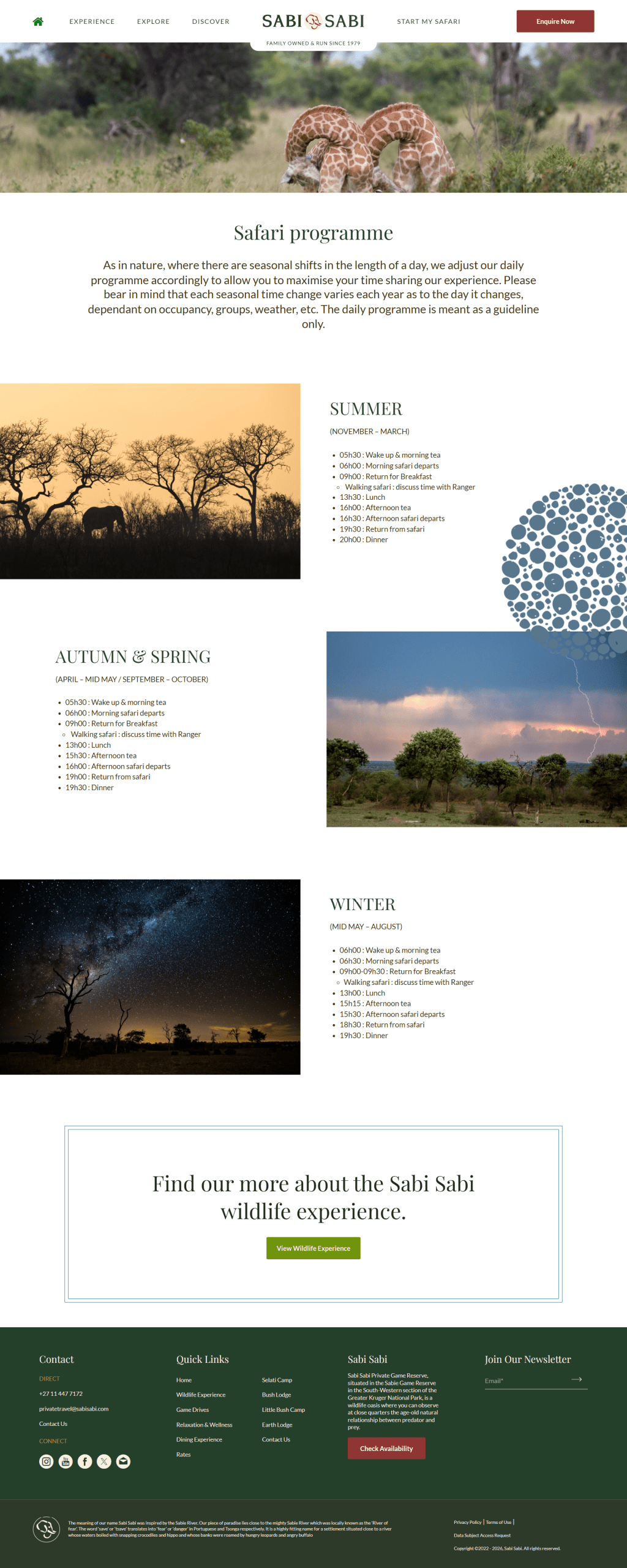
- safari programme details
- location and transfer information
- lodge fact sheets
- FAQs
This supporting content reduces uncertainty. It helps users answer practical questions without leaving the website and increases the likelihood that an enquiry will be more informed and qualified.
Mobile Experience
For an international travel brand, mobile performance is essential. Users may discover the destination through social media, editorial coverage, or travel recommendations while using a phone.
The mobile experience therefore needs to preserve the emotional quality of the photography while keeping enquiry, availability, lodge exploration, and contact actions accessible. The website’s content hierarchy lends itself well to responsive storytelling, with clear section breaks and strong visual anchors.
SEO & Discoverability
The website’s structure creates a broad organic-search footprint across commercial, informational, and inspirational intent.
Commercial pages target accommodation and booking-related searches through individual lodge pages, suite pages, rates, packages, weddings, honeymoons, and special-interest experiences.
Informational content targets wider discovery through wildlife facts, photography tips, birding, conservation, seasons, travel information, and stories from the reserve.
This combination helps Sabi Sabi reach users at different stages of the travel funnel: early inspiration, destination research, lodge comparison, and booking preparation.
Why the Website Works
The website succeeds because it avoids treating luxury travel as a simple inventory transaction.
It creates desire through imagery and narrative, provides depth through editorial and educational content, differentiates the lodge portfolio clearly, and supports conversion with practical planning tools and direct access to a reservations team.
The strongest strategic elements are:
- a clear emotional brand promise
- high-impact visual storytelling
- distinct positioning for each lodge
- layered journeys for inspiration and booking
- strong conservation and community credibility
- detailed travel-planning content
- multiple enquiry and availability pathways
- a content ecosystem that supports long consideration cycles
Result
The final platform positions Sabi Sabi as more than a collection of safari lodges. It presents the brand as a complete luxury wilderness experience built around hospitality, wildlife, conservation, culture, and personal transformation.
The site supports the entire customer journey: discovering the reserve, comparing lodges, understanding the experience, planning travel, checking availability, and contacting the reservations team.
The outcome is a premium digital platform that strengthens brand perception, encourages deeper exploration, and turns inspiration into qualified safari enquiries without compromising the sense of exclusivity.
Key points of the project
- Experience-led luxury positioning
- Four clearly differentiated lodge identities
- Immersive wildlife storytelling
- Strong enquiry and booking architecture
- High-touch reservation journey
- Conservation integrated into the brand
- Deep editorial content ecosystem
- International travel-planning support
- Premium responsive experience
- Balanced inspiration and conversion
